Thursday, April 7, 2011

From Indiana Jones to Jacques Cousteau: Backpacking Through Guatemala and Belize: Part 1

Everyone can relax, we have it on good authority from the son of a Mayan spiritual guide that the world will not end in December 2012.

Let’s go back to how we got there…..

Six hours after hopping on a bus from Copan, we were descending in the twilight into sparkling Antigua, Guatemala, shadowed even at night by the lone Volcan de Agua. Antigua felt like something from a European dream; classy boutiques, fine dining, quaint cobblestone streets and colorfully painted Spanish-style buildings. We splurged on real Italian pizza, traditional Mexican mole, and bagels with bacon cream cheese, admiring from afar the jade jewelry and five star resorts. It felt too real and posh to be Latin American, not to mention the unnerving quantity of foreigners. Still, it was a beautiful city with some interesting history. Originally known as Santiago de Los Caballeros (Saint James of the Knights), it served for 200 years as the capital of Guatemala. However, it was destroyed repeatedly by major earthquakes in 1717 and 1773 and rather than rebuild the city, they thought it would be better just to start anew and built Guatemala City an hour away (which still has earthquakes, volcanoes and sinkholes…great choice of location). Hence, the city became known as Antigua, so called because it was the old/antigua capital, and was left with ruins of ornate Baroque churches on every corner, really the only unique thing about the place. Despite its charm, or rather because of it, we found Antigua to be mostly a hippie backpacker haven and jumping off point for tours to other parts of the country.

Antigua's Central Park

Fountain in Central Park at night

At the ruins of the church on the Central Park

More ruins

Volcan de Agua behind an old archway used for nuns to cross the street

Instead of staying long in Antigua, we hopped on a bus to Xela (pronounced Shayla, also known as Quetzaltenango), the second largest city in the country and the site of more authentic Guatemalan culture. It would have been a pretty drive if not for mile after mile of dry, brown, depressing, overfarmed mountain slopes. Xela was dirty, gritty, noisy and certainly not posh, but it had a pleasant central park and nice museums with some great restaurants. The weirdest thing was the waiters who kept saying buen provecho (like bon appétit) every time they came to the table, even when no food was around. We took a free salsa class, ate tamalitos (mini tamales), saw a locally produced movie at a small theater and spent time learning about the history of famous local marimba music, world-renowned Guatemalan athletes, and antique copy machines. Some of the other random museum highlights included a theodolite (the instrument Nolan uses to do water surveys), and some pitifully taxidermied animals that were half decomposed.

Xela also has some interesting history. After Central America won its independence from Spain in 1821, it formed a unified federation of Central American states. As the republic began to crumble from civil war in 1838, the central Guatemala highlands formed a separate sixth state known as the Estado de Los Altos, of which Xela was the capital. The state faced fierce pressure from the rest of Guatemala to unify, resulting in many bloody battles, and eventually in the collapse of the Estado de Los Altos just 2 years after it was formed. The greatest lasting legacy of this state is the image of the legendary quetzal bird on the Guatemala flag, which was first featured on the Los Altos flag.

Dry hills on the way to Xela

We think these are popcorn balls, not really sure though....

Pre-cut veggies at the Xela market, how convenient!

Drinking local Cabro beer in Xela at a Texas BBQ restaurant, yum!

From Xela we took a day trip to the small town of Chichicastenango, taking the bus trip of a lifetime. While the main transportation route is a pleasantly paved five-lane super-highway, the roads wind around and up and down huge mountains constantly. It was a lot like being on that spinning ride at county fairs where you get flung into the person next to you, only since we were going around corners back and forth, you would get squished into someone on your right, then immediately thrown back to your left. We used all our arm muscles for two straight hours to keep ourselves from falling onto the Mayan woman sleeping next to us. We also decided that PCVs in Guatemala should all be issued knee-pads to wear on the bus since bracing yourself on the seat with your knees is absolutely necessary. It was then that we would witness the closest thing to an Indiana Jones move you will ever see in real life. Our bus ayudante on a chicken bus (big yellow school bus which they actually call “cheek-in buus”) stood in the front doorway, grabbed some unseen notch on the roof, stuck his foot on the window ledge and flung himself up and onto the roof in one smooth move. He clambered over the roof, adjusting and/or scaling luggage, only to somehow open the back door and swing himself in, all in less than a minute while we were still crazily careening through mountain curves. UNBELIEVABLE! At first we thought it was some strange magic trick, the disappearing ayudante, but we figured out it was a tactic used when the bus was full to collect fares in the back without marching up the jammed aisle twice.

Guatemalan bus culture will never cease to amaze us. Apparently it’s a rule that no one can be standing on a bus, unless every row has three to a seat. Sounds reasonable and safe until you realize you will never be on a bus that doesn’t have three to a seat, i.e. there will always be standing people in a modified aisle that is 8 inches wide at the most. Or rather usually two to a seat, then one large-assed man straddling the aisle with 1/8 butt cheek barely clinging to each side. The only good thing about the sardine-like configuration is that you can give your arms a rest from preventing your sideways sliding and just lean into the guys legs in the aisle with all your body weight and act like it’s no big deal. When there are just two people to a seat, beware, some tiny Mayan woman might accidentally sit down onto your lap without so much as a ‘permiso’ to indicate she had the intention of sitting. It’s like musical chairs, they start to walk by, then the music stops to they have to find a seat wherever they can, sidling in like an unwanted guest. Add in some sweat and miscellaneous body hair and you have the makings of a truly memorable Guatemalan ‘cheek-in bus’.

Anyway to get back to Chichi… As soon as we turned off the main highway and hopped on a busito, we were surrounded by people speaking a foreign language, Maya Quiche. This traditional Mayan language sounds nothing like Spanish, actually more like a Slavic dialect, and it was then we really felt we had entered a new cultural space. We arrived soon to the city center, jam-packed Thursdays and Sundays when the biweekly Mayan market takes place. We’d heard it was impossibly touristy, but were so glad we still made the trip. We hired an overpriced guide (the son of the Mayan shaman who gave us the insider info about the world not ending) to show us around, and he gave us great insight into Mayan spiritual practices. The main worship spot in town is a Catholic church built on the ruins of a Mayan shrine. The Mayans engage in their age-old spiritual practices right alongside modern Catholicism, a truly inspiring blending of religions. There are 150 men and 150 women Mayan spiritual guides at any given moment who are the only people allowed to give intercessions to the gods for others. They burn incense in lung-choking quantities and cover stone slab alters with white (for boys) and pink (for girls) rose petals and colored candles to ask for good health, safe trips, luck in love, bountiful harvest, or a good future for your kids, all in the midst of a traditional Catholic church with its own altars, shrines and prayer spaces.

Mayan women selling flowers on the church steps

Mayan woman weaving

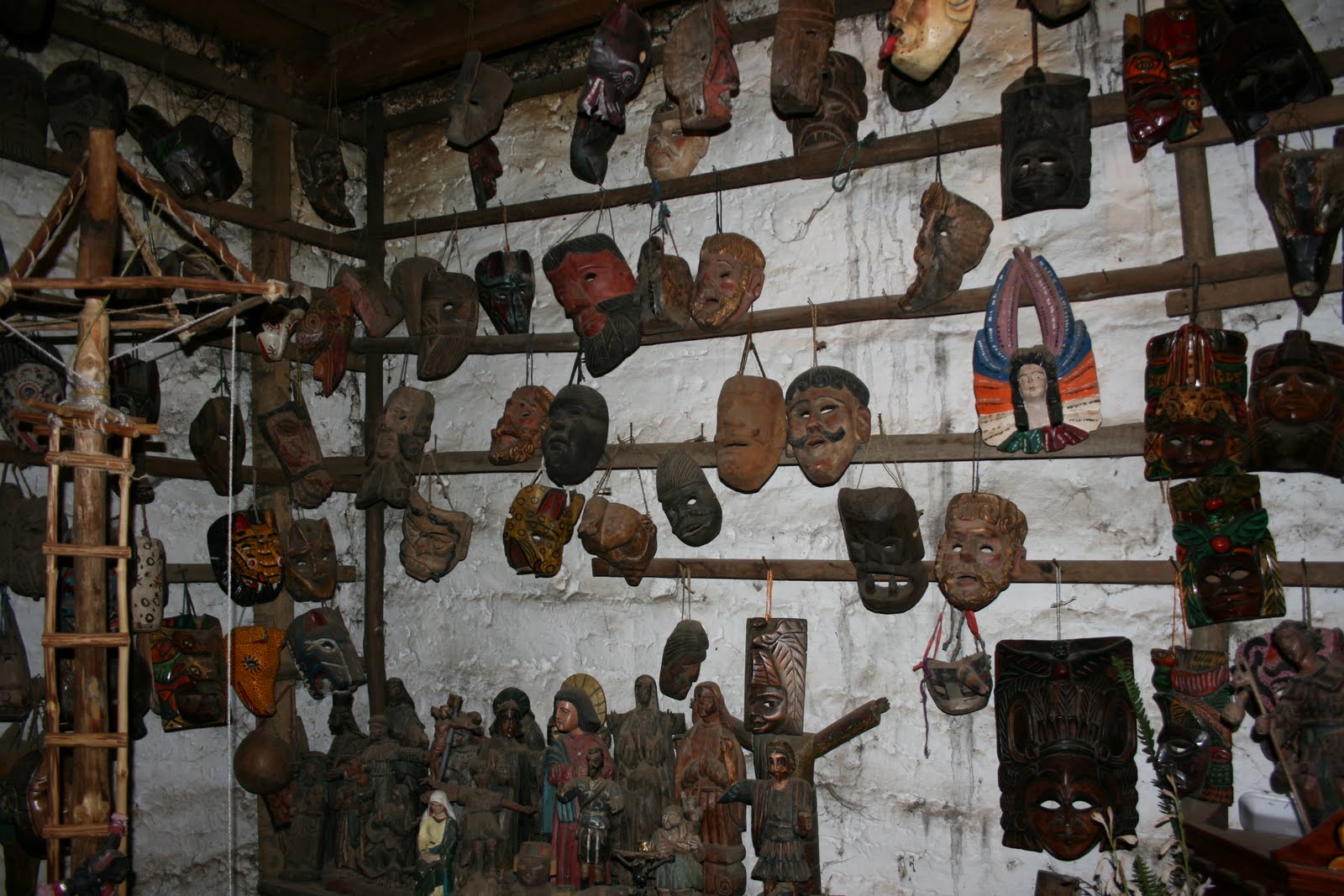
Our guide also led us up a hill near town, the top of which is a scared Mayan site. It was here that the Maya people dug from the ground a shrine, called Pascual Abaj, which they now regularly worship by burning food, Coke, flowers, candles, seeds, plants and perfume and chanting in Maya Quiche. It was an amazing privilege to witness and explore these private and sacred ceremonies, and we felt like we gained some great insight into the Mayan culture that we would have missed without our guide. On the way down we stopped at an out-of-the-way antique shop (probably in cahoots with the guide) and were able to purchase an amazing jaguar/snake wood mask that had once been used in ceremonies. The market itself was nothing spectacular, just a maze of hundreds of vendors selling almost identical products and calling out, “hey, my friend, I give you good price.” The woven items are truly spectacular in their colors and designs, some detailed shawls taking months to complete as they are woven and then embroidered by the skilled hands of Mayan women. Because of the time involved, the prices are staggering, hundreds of dollars for some items, and rightfully so. All in all, the day in Chichi was memorable, and our bus ride home just as action-packed as Raiders of the Lost Ark.

Pascual Abaj shrine

Mask store

Textile shop at the market

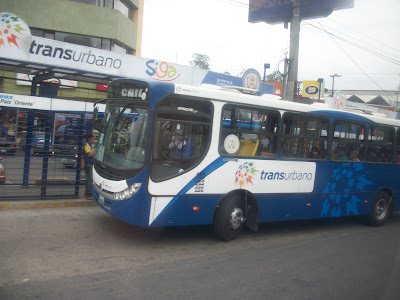
Fancy urban bus in Guatemala City

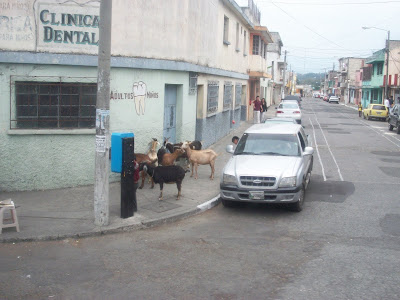
Goats on the street in Guatemala City

From Xela we stopped back in Antigua briefly before catching a loathsome 9 hour bus from there to Flores, an almost-island town in the middle of a lake in northern Guatemala. The weather got progressively warmer and more humid as we dropped from 2300-meter-high Xela to sea-level, jungle-laden Flores. Barely 8 hours after we arrived in Flores, we were on a 5 am busito headed to the ruins of Tikal. We were the first people to enter the ruins site that day, and although we missed sunrise, it was worth it to get there early to beat the crowds and the heat. We started walking up into the dense jungle, without a clear sense of where we were going. The map was little help and we could see no ruins around us. All the sudden, we stepped out from behind the trees into a little clearing and the Temple of the Great Jaguar rose 47 startling meters in front of us! It was like stepping into a different world, a different time, channeling Indiana Jones yet again as if we were on one of his hair-raising archaeological adventures. We were completely alone, surrounded by screeching birds and roaring howler monkeys, surrounded on all sides by massive, beautiful stone temples rising from the jungle floor.

First people in Tikal for the day!

Temple of the Great Jaguar as we saw it for the first time, rising out of the jungle

Tikal is impressive because of the size of its temples, six in all, four over 45 meters (~150 feet ) tall, and most of which you can climb up on creaky wooden stairs (they don’t let you climb the steep steps in front, with good reason, people have died) then look out over the jungle for miles. The temples have lost most if not all of their decorative carvings and color, so you can only try to imagine what they looked like at the height of the civilization. What’s even more amazing is the fact that this incredibly important and powerful site was “lost” in the jungle for hundreds of years after the Maya people abandoned it and that only in the past 10-20 years archaeologists have completed digging out and renovating many of the grand monuments. Thousands more structures have yet to be recovered from the fast-growing jungle vegetation that covers them in soil and roots in no time. You sort of wish it just always looked the way it does now and that people found it intact, but everything you see has been restored. Also, because it was not near any body of water, Tikal had a very intricate system of water catchment ponds and canals that served nearly 100,000 people at its height.

Sign with Mayan language

Nolan hanging out - pretty steep steps!

View from Temple IV overlooking the area of the ruins - amazing view!

Hot and sweaty even at 7 am

The stairs we climbed to get to the top...

After five hours we were exhausted by Tikal, despite there being so much more to see, and headed back to Flores on the bus, missing almost entirely the busloads of khaki-short-wearing tourists and escout troops that were right on our heels. We spent the rest of the day relaxing in hammocks overlooking the lake surrounding Flores, catching up on some much needed sleep and drinking a gallon of water to replenish the bodily fluids we were sweating away and an unprecedented rate. After a delicious traditional Mayan chicken dinner, we fell into bed and slept away our last night in Guatemala.

Rooftop at our hotel in Flores

To be continued...

Friday, March 18, 2011

Oregano for Your Bed

We had another exhausting week interpreting for a medical brigade from Ohio a few weeks ago, but this one was more dynamic. Half of the 34 people who came down from Toledo were medical students (including a girl who was Nicki’s hall mate sophomore year at UofM) so they were more our age. There were also, as we found out, some world-class doctors among us from institutions like the Mayo Clinic. Among the PCV’s, we decided the best part of the brigade was the intellectual stimulation of talking and sharing stories with young, hard-working, dedicated professionals, a sector of society that doesn’t really exist here in Honduras. We imagine it was a pretty amazing experience for them as students also to get this kind of practice and exposure.

Nicki and her college hall mate

Diploma given to the brigade, can you spot the misspelled state?

The whole group was upbeat and fun, which made up for the few nights when we worked until it was dark outside. We both had a chance to work in “triage” i.e. patient intake, “clinic” i.e. patient visits, and the pharmacy, so we saw all sides of the process. Some of the highlights were: Nolan teaching people how to use the 170 ceramic water filters that World Vision donated to various families, watching some makeshift medical procedures such as removing moles and injecting steroids with the people lying down on a kids writing desk, giving medical attention to 2,244 people over 5 days, and our end of the week farewell dinner which turned into an all night drunken dance party.

Nolan helping put together water filters

Despedida for our brigade friends

Of course we encountered the same old problems. People self-medicate too much, giving themselves and their kids amoxicillin for any cold-like illness. And who wouldn’t really? You see the doctor prescribe it, then the next time your kid is sick with anything, you figure it’s the same thing and can run to the open air market to pick up some amoxicillin for L.1 (5 US cents) a pill. Of course, if you know medicine you know this builds immunity for when the kids really need antibiotics. People don’t drink enough water, leading to headaches, urinary problems and general malaise. But getting people to change that habit is next to impossible. Everyone wants their teeth pulled because they are rotting out of their heads. Ninety percent of people just have arthritis and muscle aches from daily living, carrying bags on their back/shoulders, using a machete, walking 6 hours a day, making 100’s of tortillas and the like. The brigade was great because at the end you feel like you did something more tangible than your normal day-to-day activities, but then you think back and wonder about the real effects of just giving someone 30 days worth of pills for back pain. To be fair, some people get real help, referrals to specialists for surgeries, a year’s worth of hypertension or diabetes meds, glasses, or asthma inhalers, and helping those people is what makes it worth it.

Nicki interpreting

Dr. Nolan examining ears

Communities rely on medical brigades for a lot of health services which is obviously unsustainable in the long run. Unfortunately, my women’s cooperative, UMMIL, relies on the medical brigades for profit (L. 7,000 of business in one hour is worth a month to them), so if the brigades are unsustainable, UMMIL is unsustainable. It’s an economic cycle riddled with problems.

A few random stories to tide you over until we get back from our vacation to Guatemala/Belize:

Random story 1: We were invited to attend the swearing in of the new Business Chamber of Commerce because this woman I work with was the newly elected president. After getting started and hour late then barely making it through another hour of painfully similar welcome speeches that all touched on the wonderful climate of La Esperanza, we were served dinner and struck up conversation with a chamber member. He was an ex-teacher who was extremely well travelled and educated, enlightening us on Machu Picchu, Brazil and the benefits and problems of natural healing and acupuncture for ruptured discs. Nicki told him she was an urban planner and he immediately said something like, I’ve heard of this new planning model where instead of separating things, they mix it all together in one area, like living and shopping and work. We were awed into silence that this random Honduran man was up on the contemporary idea of mixed-use planning. Of course we explained it was a popular and useful idea so that people could walk more, drive less and in general live better lives. Of course, he replied, if people were walking all the time it would reduce rates of obesity (!). Nicki wanted to jump out of her seat and scream, Yes! Someone here gets it!, but she refrained. Maybe there is hope for urban planning in Honduras after all.

Random story 2 (non Honduras related): Nicki got an email a few days ago. The guy, from New Zealand, said that he had just read her online article on urban growth boundaries, thought it was a very good analysis, and would like to know if she was still researching in that field. Of course the article he was referring to was a project she had done sophomore year at UofM (before ever becoming a planner), that she had never expected anyone would be reading, much less commenting on. After a quick reply (after all, it could have been a big job opportunity or something) it turned out the guy was an anti-urban growth boundary fanatic who just wanted to impress his ideals on anyone who didn’t give a completely complimentary review of UGB’s. Looks like there will be no New Zealand job offers in the near future. (Not that I’m totally for UGB’s, but I’m against fanatics).

Random story 3: We went on a search in the market for some oregano, since we had just run out. We’d seen it before and quickly found the stand with guy selling huge bags for L.5. Upon buying one, the guy said, “It’s oregano, for your bed!” We were already turning away so neglected to ask what exactly he meant by that….

Friday, March 4, 2011

Our New Honduran Obsession

Or actually, a somewhat old obsession that has been recently rekindled. Yes, I’m talking about Honduras’ beloved national music idol and Claro spokesperson, POLACHE!

Where did it all begin? Hard to say really. We were introduced to his music during training, a national empowerment song called Mira Honduras, and were struck by the clever lyrics and soulfully raspy voice. The singer sounded like an older man, but after getting into reading the local newspaper we were struck by full page ad of the musician for Claro (cell phones, internet etc), rocking out on his guitar with jeans, a sleeveless tee and crisp straw cowboy hat, a lad in his mid-thirties perhaps in need of some orthodontia work. Before we knew what was happening, we proceeded to download his entire first album and were quickly enchanted. Polache, despite being of half English descent and named Paul Hughes (Pol-ache is for Paul H), is a real champion of Honduran culture and full of national pride. His songs use Honduran slang, caliche, to describe what life is really like here. The music is simultaneously upbeat, comical and thoughtful, making for pure listening pleasure. We were hooked.


Polache is not well-known at all outside this small country. Having grown up in Teguz and then relocating to San Pedro, he worked in an ad agency before a hit ad song he wrote sprung him only recently to nationally acclaimed fame. His music being so provincial, in a good way of course, his fans and following are limited to mostly locals. We can only imagine that vast majority of his gigs are small town festivals and soccer game intermissions, which together with some records on itunes provide him a decent living. It was such a festival that would bring us face to face with the rock star.

It was a weekend like most in La Esperanza, a chill hung in the air with the threat of rain hovering in clouds pressed against the mountains. But this weekend was a special treat, the Feria de Artesania de La Ruta Lenca, an homage to the artistic legacy that the Lenca people have maintained in this area of the country. It seemed more like a pupusa festival to us, vendors lining the streets selling their oozing pupusas surrounded by various art products, textiles, pottery, opals and a handful of other junk. Sidenote: Honduras is one of only a handful of countries that commercially mines a decent amount of opals, and the prices here compared to elsewhere are stunningly cheap. We bought four loose opals for less than $25, whereas one of them in Australia might have cost $100. So there we were, lazily strolling along when our ears perked up, the announcer had said something about Polache. We quickly asked a nearby vendor who confirmed that Polache was in fact coming to sing and sign autographs Sunday morning at 10 am! Disregarding the strange time of his visit, we decided then and there to be present.

So Sunday morning came. Our friends Pat and Megan had spent the night, and we ushered them up, through breakfast and out the door, anxious to get to the concert. We spent our waiting time discussing whether or not the sleeveless shirt and cowboy hat look was something that Polache himself contrived or whether it was a marketing stunt designed by Claro. I think we concluded it was of his own doing. Of course Polache didn’t arrive until nearly 11, but it was well worth the wait. What a stage presence! Every bit as entertaining, charming and genuine as we’d imagined, he wooed the crowd with favorites from his old CD and highlights of the new, interjected with his favorite word, ‘papita.’ At one point he even invited three women on-stage and proceeded to make up clever song lines about them using their names on the spot. The only thing lacking of course was the crowd. At 11 am on a Sunday morning, I’m surprised he even drew the small crowd he did, what with this being an extremely religiously devoted country. Hondurans seem to lack the spirit of concert participation so Polache’s call-and-response tactics, commentary and antics largely fell with a thud onto the motionless crowd. Of course there we were, front row, bopping along to the music, snapping pics and videos galore, like teenage girls at a boy band concert.

When the concert was over we rushed, amidst a group of 10 year olds mostly, to Polache’s side to get his illegible autograph on a mini Honduran flag, perhaps the closest we’d ever been to any type of celebrity. Then he was gone before we knew it, whisked away in his sparkling Toyota Tacoma, leaving a warm spot in our hearts that can only be filled with his captivating music until he returns to us. The obsession has been reignited! POLACHE! POLACHE!

Sunday, February 27, 2011

Michigan Eye and Dental Brigade

We spent all last week interpreting for a medical brigade from Michigan that came to La Esperanza, so we thought we’d give you all some of the highlights. The brigade is part of a partnership between the Lions Club here and in Michigan. Every year eye doctors and dentists come to La Esperanza around this time of year to offer free services. We headed over to the Lions Club building on Sunday afternoon, thinking we were having a meeting to get to know everyone. To our surprise, the brigade was already getting started so we jumped right into interpreting.

People waiting in line

We started out helping with acuity tests (reading the eye chart at distance and close up) which was pretty boring, but quickly moved to where we were really needed, assisting the ophthalmologists as they asked patients questions and provided diagnoses and treatments. There was actually very little interpreting that needed to be done. The doctors only ask a few questions (Having any problems? Which is better, 1 or 2? etc), and most of the visit is looking at their eyes, which just requires you to tell them to keep their head straight and look into the distance, which for some reason was really tricky for most people. The doctors have also been coming for quite some time, a few for 20 years, so they spoke a little Spanish too. The dentists had everything covered so no interpreter was necessary. Our friends Zach and Karl from nearby sites came in for the week to help out, and having the extra company made it more fun.

Distance acuity test

Up close acuity test

Eye pressure check

Eye exam

Zach interpreting for Dr. Bob

Karl interpreting

As usual the patients who come to the brigade, rich and poor, figure out exactly what they need to complain of to the doctors in order to get new glasses or eye drops. The doctors really only half mind the lying. After awhile they were almost automatically giving everyone reading glasses, sunglasses and moisturizing drops. The funniest was one little kid, really intent on getting some glasses. The doctor began asking which lenses were better, moving the prescription up and up as the kid said each successive lens was better. Then the doctor started to go back down in prescription, and the little kid continued saying it was better and better until it the doctor got to zero prescription, which the kid still insisted was better than the last. That little guy didn’t get any glasses.

Nolan helping Iliona, our favorite little girl, get new glasses

The best part was meeting people. The brigade brought not only doctors and dentists but a bunch of others to help out with acuity tests, x-rays, and glasses fittings, most of whom were not eye doctors or hygienists or anything in the field of medicine. Several were teachers, another worked at the Michigan Forest Association, and many were retired. It was nice to chat with them, having Michigan in common, and sharing some of our insights into Honduran culture. We met people from the Lions Club in La Esperanza (Club de Leones) who, as you might expect, are the wealthy movers and shakers in the community that we now have connections with. We also ran into a bunch of people we already knew from around town and made friends with some new people, a couple who owns a hotel, a woman who works at the grocery store and a guy from the radio station.

Bill and Johnny

Toby was a balloon artist and made this little girl a house

Nolan had a couple opportunities to work with the dentists, so I’ll let him tell you about that….

Like Nicki mentioned, the dentists had things pretty much covered, they had one high school Spanish teacher with them who did most of their interpreting. Since there is less talking with the dentists than the eye doctors, she was able to go back and forth between the dentist and the hygienist. There were, however, a couple times when she was somewhere else, so I went and interpreted for the hygienist. The first and most interesting time, I helped explain to a young boy that she had to give him a shot to numb his mouth, and then that she was going to pull two baby teeth, and three rotted roots. The kid seemed to take it pretty well, didn’t want his dad in the room, and only started to cry when the dentist came and gave him a shot in the roof of his mouth. All the doctors brought little toys and things to give to the kids after they saw them, so he got several things, and seemed happy enough when it was over. The only real problem is that with a diet of coke and churros (chips) the kid will probably be back next year to have more rotting teeth pulled.

The hygienist doing a cleaning

Dentist doing an extraction

The best day of the brigade for me, however, was the last day. The dental team spilt up into two groups to go to two different schools to teach the kids about brushing their teeth and also to administer fluoride treatments. I had been asked earlier in the week if I could help with the second group, so on Thursday I left early to go with them. The school we went to was not that far out of town, but it was still far enough that all 6 grades (37 students total) were in one class. A nearby school ended up coming down so we gave the presentation twice to 77 kids total (the other dental group presented to 200 students). The presentation consisted of the dental hygienist explaining how to brush your teeth (for 2 min, in circles, etc) in English, and me translating what she said into Spanish. We then explained about the fluoride treatment and how we would administer it. In the first class, one of the 1st graders burst into tears when were explaining it. Once we figured out why he was crying, he thought we wanted to pull out all his teeth and give him a shot (how he came to that conclusion we have no idea), we were able to calm him down, but he never did let us give him the treatment. Another cute interaction was when we asked for questions, and if they understood what we were saying. One boy raised his hand and said he didn’t understand. It also took us awhile, but eventually he said he didn’t understand the dental team, and the teacher explained that that was because they were speaking English, and that I was there to translate what they said for the students.

After the presentation, we started the fluoride application. Basically, what we did was put on latex gloves, squirt a little fluoride cream onto our hand, and brush the fluoride onto the kid’s teeth. Other than the one kid, it was pretty easy to get them excited about it. We told them that it tasted like gum, but that they shouldn’t swallow it, and they couldn’t eat anything for at least 30 minutes afterward. At the end, we left each class with toothbrushes and toothpaste, enough fluoride for two more treatments, and a couple boxes of school supplies, all of which (toothbrushes, pencils, protractors, everything) the kids will keep at school, use during class, and leave there at the end of the day. This is so they don’t bring it home and lose it. It’s the safest thing to do here where people don’t brush their teeth because they can’t afford toothpaste.

Nolan applying fluoride treatment

Hygienist applying fluoride treatment

Maybe it wasn't such a good idea handing out those latex gloves...

Thursday was our last day, and we said farewell to the doctors and brigade members at a despedida (going away party) at our favorite local restaurant/dance club/sports bar, El Fogon. In typical Honduran style everyone arrived about an hour late, people gave speeches in English and Spanish that were oddly translated and repetitive, and everyone received at least one diploma (we got two, haha!). We were also gifted some Michigan wine and chocolates for our interpreting services. We had a full dinner with an open bar followed by cake and dancing to songs of the 80’s, 90’s and today. I suppose they chose U.S. pop songs because the brigade was from the U.S., but it felt tacky and lacking in Latin flavor.

The brigade comes every year and should come again before we leave, so we'll have a chance to see our new friends again next year.

Saturday, February 19, 2011

A New Perspective

It has been a couple weeks since I returned, but I am finally getting around to writing about my translating experience (or to be grammatically correct, my interpretation experience).

I was first approached several months ago about my interest, if any, in helping to interpret for a member of the Virginia Medical Center Brigade. While the guy I would help would be a member of the brigade, the work would not be interpreting for doctors treating patients. The brigade has been coming to Honduras, to the city and aldeas of Comayagua specifically, for 10 years or so. A few years ago, in an effort to become more sustainable, they started training ‘Community Health Workers’ who could work in local clinics throughout the year when the doctors were not there. While training the Community Health Workers, they realized that many of the communities they were working with did not have clean, easily accessible water. Because clean water, and the education to properly use it, is perhaps the best preventative medicine they could give, the brigade decided to build water systems for these people. The guy they put in charge of overseeing these water projects, Dan, is a retired real estate developer, and because he doesn’t speak much Spanish, he has always had Peace Corps volunteers accompany him on his trips to help. The current volunteer that he has been working with finishes his service in May, so he was looking for new help, and another volunteer and I responded.

Dan flew into Tegucigalpa on a Monday, so three of us PCV’s met him at the Peace Corps office. He wanted to quickly meet Emily, our new Peace Corps Honduras directora, before going to review the current status of the as-built plans of the water system at the engineering office. At this point, I was just along for the ride, learning what I could about the system. Once those meeting were finished, we were off to Comayagua. It was already night, but after the 2 hour drive, we still had another meeting at our hotel to review the blueprints for an orphanage that the brigade wants to build in La Paz, a nearby city. We met with the architect over dinner at the hotel, and got to bed relatively early.

In order to fit everything in, we got started early the next day. We went to the current orphanage (in an old falling apart school building) to meet with the nun who runs it. We wanted to show her the plans before we met with the mayor and city council to give them an update on our progress. After those meetings, the plan was actually completely changed, so we will see how the architect redesigns it next time. The orphans were very cute. We got there right as they were waking up, and the first thing they all did when they came out of their bedrooms was come and give each of us a hug.

Comayagua is actually one of the bigger cities in Honduras, so obviously we weren’t going to stay there to help with water projects. We had to go up about an hour and a half into the mountains, about an hour past where the last bus reaches. We were going to be camping up there for 4 nights, so once we had stocked up on food for the week, we set off. Our camp site turned out to be near the top of the mountain in a clearing that serves as a typical Honduran aldea center. There was a soccer field, a school, a church, and the new clinic that the brigade was having built. It was actually quite a dense ‘downtown’ for a community like this. We set up our tents, and reviewed the plan for the week while waiting for church to end so the woman who had agreed to cook for us could make dinner.

Campsite at the top of the mountain

One of the ways to try to get the community to take ownership of a water system is to get them as involved as possible. The community typically provides sand, rocks, wood. They do all the unqualified labor including digging ditches for the tubes, and chopping and carrying equipment for the topographer. Being a machismo society, those are all typically male jobs. The women usually provide food. I always get lunch made and brought to me when I survey, and here, while we bought the food, we were having all our meals cooked for us.

Ready to help

The next three days were spent inspecting various parts of the water system. We walked along the along the line, making sure everything was in order, noting when there were small things that still needed to be added or changed. We also had to count the pipe anchor in places where the pipe couldn’t be buried. This was to make sure that the Brigade was paying for the actual number of anchors that were built. Because all my work thus far has been on theoretical water systems that may or may not be built during my service, it was very interesting to get a chance to see a currently functioning water system. Plus, inspecting it with people who have done this before gave me insight into what to look for in current systems. I have tried to inspect one system before, but I didn’t really know what to look for. Now, I have a much better idea what can go wrong, and where to look.

Lonely water tank

Riding up the mountain...can you say fresa

Counting the anchors

Taking a break from the hike

In addition to the inspection, we also met with the junta de agua, the local water board. This system is actually quite a large rural water system, serving 8 different communities. Because of this, each community has their own water board for their section of the system, which together forms the general water board for the entire system. Serving so many communities, there are bound to be differences of opinions, which we experienced during the meeting. It was our first real test of interpreting, trying to keep up with the argument while translating simultaneously. In the middle of the meeting, the general water board president said he was resigning, and walked out. After the meeting, we went down to his house to talk to him. He felt no one appreciated him, and that he was receiving all the blame for everything. We told him to take some time to think about his decision, and by the next day when we were leaving, he had decided not to resign. Of course, that brought up some other complications. After the resignation, we had effectively put the VP in charge, and no one was sure if it was possible for the president to renounce his resignation. It turns out that a verbal resignation doesn’t mean much, and since he didn’t sign anything, he had not officially resigned, and remained the president, so everything turned out fine.

We had been camping for 4 days, not only subject to the local politics of rural Honduras, but also the local microclimates. Our camp site was high enough in the mountains to be in the clouds, and after the first nice clear day, we had essentially been in at best a misty rain the whole time with actual rain at night. We were wet and ready to head down to the valley. Because of the rain, the roads had become impassable, but luckily we had parked the trucks a little way down, below the scary muddy cliff hugging roads. Once we safely made it down, we got cleaned up for a nice dinner to celebrate the week.

Dan and his pack mule, Selvin (Selvin carried his backpack the whole week)

We camped above this lower edge of the clouds

We stayed in Comayagua one extra day in order to meet with a community that the brigade had built a water system for 2 years ago. We wanted to visit and make sure everything was still going smoothly for them. As it turns out, the water board was at the end of their term so we were able to experience the election of the new board. Of course, nothing much changed; all the current members were reelected, with the community just electing people to the positions that were missing. Everyone there seemed very competent, and it gave me hope to see a community with such a well functioning water system, they were even properly chlorinating! Que bien!

It was a tiring week, but I learned a lot, met some new people, and am looking forward to accompanying Dan on his next trip down here.