Tuesday, March 20, 2012

Bustling Bogotá

After an agonizing 20-hour turned 26-hour bus ride from Cartagena, we pulled into the bus terminal and breathed a sigh of relief that we were out of the hot coastal area and instead sitting comfortably at 2,600 m (~8,500 ft) in Bogotá, the fourth highest capital in the world after La Paz, Quito, and Thimpu. The bus ride had us scared for a second when it departed Cartagena northward, travelling along the Caribbean Coast. We were sure we’d gotten on the wrong bus until we eventually turned southward, the first of many strange twists and turns the bus would take to arrive at the centrally located capital. We hopped on an urban busito and headed for our hostel, finding it with no trouble despite the street numbers having recently been changed. It was refreshing to be in a real big city, and it helped that the annual temperature hovers steadily around 60 degrees.

We started our city exploration with an early morning trip up to Cerro Monserrate, one of many large mountain peaks that create Bogota’s eastern urban border. The funicular train was out of service, so we zipped 200 meters up to the top via cable car. The views were breathtaking, literally. Having just come from sea level to 2,800 meters, every step seemed like a huge chore and we were soon winded. Fittingly, at the top, dozens of little shops sell coca tea, leaves of the same plant that produces cocaine, which are steeped and sugared to make a tasty fusion that cures altitude sickness (well, it tasted grassy to be honest, but the sugar helped). It seemed to work, since we didn’t have any more problems in Bogotá. We snapped dozens of shots of the church that sits atop the mount and the manicured gardens, shops and restaurants that surround it. People do hike up the mountain as a sort of penitence, but we heard it was dangerous so we cabled car-ed it back down.

View of the cable car and city from the top

Tasting coca tea - Don't worry, it's not illegal!

View over sprawling Bogotá

The funniest thing happened when we were up there though. A group of high school kids approached us in a furry and began asking us all kinds of questions, where we were from, if we spoke Spanish, if we had kids, where we were travelling. They were trying to pretend they knew English but could only get out “cost of transportation?” Hah. They also thought Nolan could pass for a Colombiano. It was a little intimidating having 20 kids all asking you questions at once and cooing every time you answered, but it was funny too. As soon as they saw some other gringos, they ditched us. Maybe it was a class assignment to talk to foreigners?

At the base of the cerro, we stopped in at Quinta de Bolívar, the temporary house or inn of the legendary Simon Bolívar from 1820 until 1830. Bolívar led many countries in South America to freedom from Spain (more on him later) and as such, is always referred to as “the Liberator.” The house wasn’t specially built for him or anything, and he only sort of temporarily lived there with his wife/mistress Manuela, but it was a great peek into the life and times of colonial Colombia. It had an extensive labyrinth of manicured gardens and a vegetable/medicinal/herb plot. The house itself had some great period furniture and a replica of a famous sword given to Bolívar by the city of Lima. It also had a fantastic breezy dining room where in the early 1800’s, the signs explained, culinary habits were beginning to change from full-service to buffet style. The kitchen was of course my favorite room with a huge blackened stove, old skin wine casks and antique utensils. It was serene spending time at his little hacienda, removed from the bustle of the city and nestled in the foothills.

Kitchen inside la Quinta

Gardens at la Quinta
Bogotá had so many great sights to see, it was hard to take them all in. With over 7.8 million people and an urban footprint of 613 square miles, we barely scratched the surface in our few days there. We stayed in the La Candelaria district, which is basically the old town. However it didn’t have exactly the Spanish colonial feel of other places we’ve visited. While there were some colorful colonial buildings, we also spotted art deco and even English style row homes in addition to the newer apartments and high rises that are beginning to infiltrate the downtown core. La Candelaria has a cluster of churches and restaurants which make it pleasant for strolling. It’s also home to Plaza Bolívar, a Trafalgar Square-esque place that has the primary cathedral, but also the Supreme Court building, city hall of Bogotá, and the building of the National Congress which backs up to the president’s quarters and other governmental buildings. It was very monumental to say the least, but not as pleasant as some other parks we visited later on.

Congress Building in Plaza Bolívar
Bogotá is known as the “Athens of Latin America” due to its high concentration of universities, which we can attest to having walked past dozens of them as we strolled the streets. It also has some great museums we visited. The first was the Donación Botero, a collection of works done by Francisco Botero himself and other famous artists from his personal collection. Botero is a contemporary Colombian artist, from Medellín actually, that has a peculiar style of painting and sculpting everything quite fat. Not just people, but animals, fruits and even furniture have a stocky nature to them. He’s quite famous and the museum housed a wonderful collection of his works, augmented by Picasso’s, Monet’s and others.

Botero hand
Botero Mona Lisa
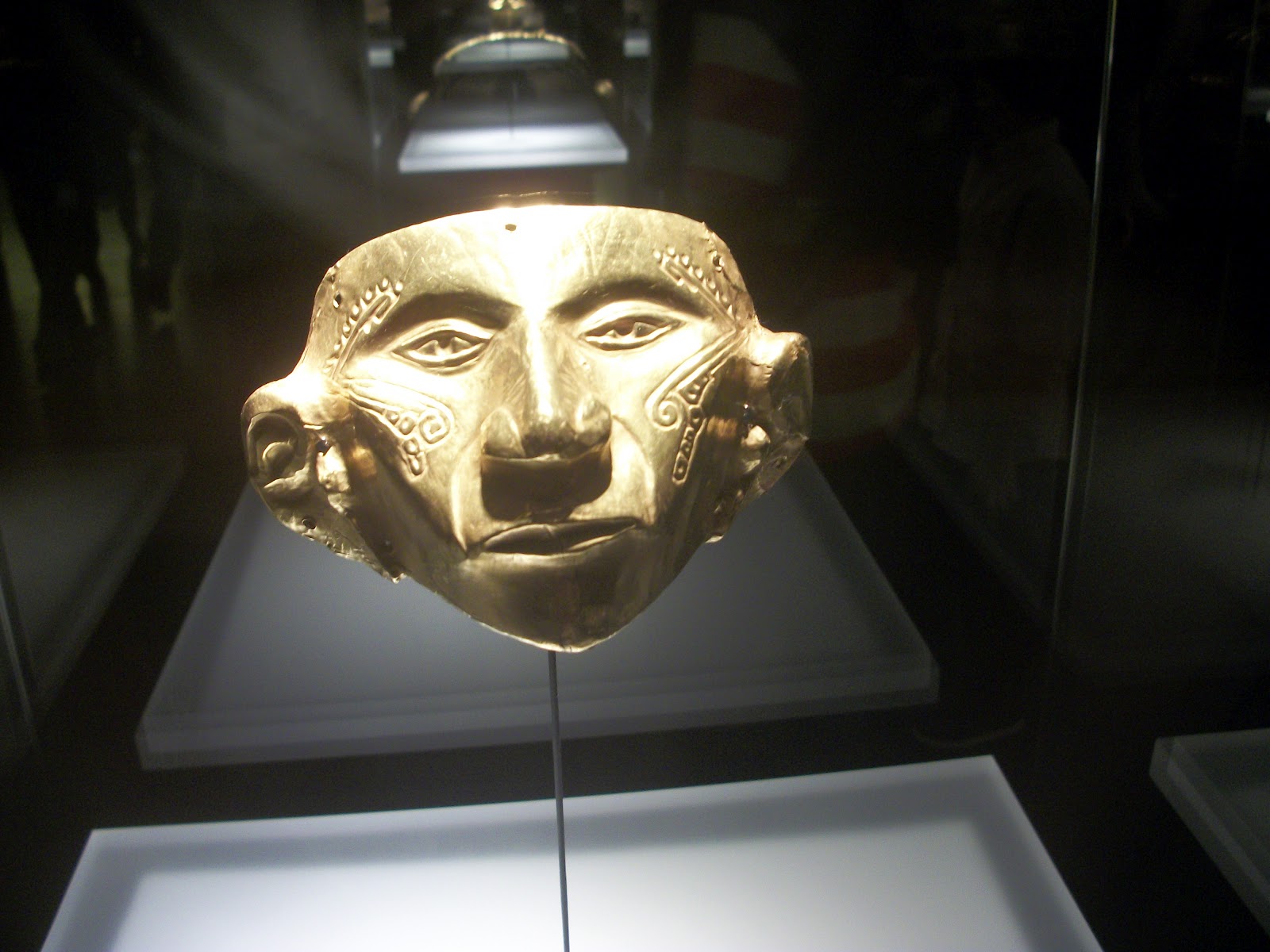
 The second and even more famous museum is the Museo de Oro, or gold museum, which has a huge collection of Pre-Colombian gold artifacts from all over the country. It was really well done with all the information in well-written English (surprise!) and had thousands and thousands of amazing pieces. We saw everything from jewelry and ornamental sculptures to tools used in religious ceremonies and musical instruments. Amazingly, the Native Americans were skilled at making alloys with gold, platinum, bronze, copper and silver and perfected many techniques including hammering and the lost wax process.

Gold mask
In between all this sightseeing, we enjoyed a variety of delicious food. Colombia and Panama don’t have tortillas like many other Latin countries. Their equivalent is the arepa, which I previously mentioned, a thick cornmeal patty grilled and stuffed with a variety of ingredients. We found that eggs or shredded meat and cheese are the best, hot off the street from a guy with a grill on the front of his bike! Genius! They also sell amazing fresh potato chips and sweet churros on the street, as well as fried sausages and a grilled corn (choclo), which is so crispy after grilling that it tastes almost like popcorn. Empanadas abound with every filling imaginable, including a mix of cheese and guava jelly (not great). Colombian’s also love their sweets, particularly anything flavored with caramel syrup called arequipe. They eat it smeared between two wafer discs with other toppings like jelly or cheese. 
Bogotanos in particular are getting into microbrews and they have a famous chain called the Bogota Beer Company, which we stopped at to have some tasty Belgian style ales. We felt like we were back in the States, sipping delicious beer among hip and trendy college kids and young professionals. We heard Colombia has great hamburgers, but the few we tried weren’t that spectacular. Sadly we also missed out on eating lechona (a stuffed pig) and ajiaco (chicken and potato stew), since most of the restaurants were closed both Saturday and Sunday afternoon/evening. We did buy a famous Chamba ceramic cooking pot though which will be great to try making beans or stews in back home.

Wafer with arequipe

Crispy choclo
But beyond the food and the culture, what we loved most about Bogotá, was its urban-ness… which is the subject of the upcoming blog, so stay tuned!

Thursday, March 15, 2012

On a new continent

With our arrival in Cartagena, we stepped foot on another continent(!), although really nothing much appeared to have changed. Cartagena seemed a lot like Panama City, an old colonial town separated from a new beach and high rise sector. Yet Cartagena had a very vibrant feel and more beautifully restored buildings. We spent most of the time walking within the walled old city which, in addition to the typical ornate churches and repetitive souvenir shops, had tons of upscale shopping, dining and hotels plus more bookstores (3) per square mile than we’ve seen anywhere else in Latin America. The parks were wonderfully landscaped and bustling with break dancers, colorful fruit vendors and mobile ice cream and beer (yes, beer) vendors.


We love the colors and the cool vine of this streetscape
Something akin to the Chiquita banana lady
Interesting mixed market - flowers and typing services
 We spent lots of time wandering the cobbled streets among horse carts and sampling the cheap and delicious local food. The street food was a variety of fried doughy items stuffed with eggs, potatoes or meat. The most common is an arepa which is a grilled or fried corn tortilla meal stuffed with cheese, meat, eggs or margarine. They also have amazing set lunch dinner specials that include a bowl of soup, a plate of meat/rice/salad/beans and juice for about $3 – yummy and cheap!

Chicken soup and fried fish lunch plate all for $3!
 Although Cartagena has a wall around it, built for protection from sea attacks, it also has a huge fort on the hill behind town to protect from land attacks, el Castillo de San Felipe. It was a short but extremely hot walk from out hotel to arrive at the entrance where thousands of cruise ship passengers had begun to swarm. Amidst pestering vendors, we climbed the fort and explored its batteries and dark underground storage tunnels. There were great views of the new and old towns and the water beyond – too bad it was so hot and humid. We also checked out an interesting city museum housed in the old Palace of the Inquisition. This was the spot where heretics and witches were accused, tried and tortured in the name of the Catholic Church. Today it is restored and has a great exhibit about how Cartagena came to thrive as a major Caribbean trading port with an ethnic mix of citizens, but then lost power as a result of its quest for independence from Spain. It lapsed into a city decimated by disease and lost investment and it’s only in the last 100 years that it has again begun to redevelop.

Looking up at the fort
On top of the fort with the city behind
 On our last day, we took a tour to Volcan Totumo, a dry conical volcano-like column of medicinal mud that bubbles up from the earth. It’s a popular spot 45 minutes from the city to go soak for awhile and then wash off in the nearby lake, which is exactly what we did. They have a series of helpers that pull you into the mud pit, slather you with mud, give you a massage and then push you around. The mud has a strange consistency and even though the volcano is hundreds of meters deep, because of the density, people just float on the top at about chest level. It’s scary to think about just floating there on to, but you can’t really move much without help. We were packed in with about 40 other people and soaked for awhile. They slough the mud off you and you can let it dry like a mud mask to purify the skin. Then you hop in the lake nearby to rinse it off. It was quite an experience – one we would highly recommend to anyone visiting.

Before our soak in the volcano
It's nearly impossible to move in the mud, not up, down, or sideways
Let the mud dry before you wash off to maximize the benefits
Despite still feeling the rocking sensation from out boat trip three days later, we enjoyed exploring Cartagena, even the dingier local areas where we hunted out cheap food and great photos. We found the people to be very helpful and thoughtful. The housekeeper at our hotel was so sweet, when we left, she said she would miss having us at breakfast in the morning! Even though Cartagena was a stunning city (the old town at least), we were happy to move on to cooler weather in the Andes in Bogotá, which is exactly where a 26 hour bus trip landed us next. 

Sunday, March 11, 2012

A pirate’s life is not the life for us

What we discovered after 5 days and 5 nights crossing the Caribbean from Portobelo, Panama to Cartagena, Colombia is that we are land lubbers. Let me explain. Portobelo is a small, breezy port town with nothing more than a few old forts and one backpacker hostel where we met our boat crew and fellow voyagers for our trip. We boarded the ship late in the afternoon for an all night ride out to the San Blas Islands off the northeast coast of Panama. As George Kastanza would have said, “The sea was angry that day my friends.” Within hours of departing and despite taking several seasickness pills, the huge rolling waves whipped up by brutal wind sent me spewing my lunch and dinner over the side of our brigantine schooner. I wasn’t the only one. During the course of the night, almost everyone on board was sick, even Nolan who normally has a stomach of steel. We had the roomiest “double suite” which was no more than a slim triangular bed tucked in a corner of the bow that was hot, stuffy and uncomfortable, but so much better than the layered bunk beds. Laying down provided the only relief from sickness, but being below deck was the last place one wanted to be.

View of Portobelo from the mountain lookout
Remnants of the Portobelo fort
Our boat (a 64 ft brigantine schooner) is the one to the right behind the front boat
Our cabin
Waking up to smooth seas and an eyeful of palm tree encrusted islets was a wholly uplifting event. With the boat anchored, we had time to do some snorkeling and swimming, as well as explore the nearby uninhabited islands. The smooth water made for easier sleeping and eating. Despite the cloudiness, there was no rain and we enjoyed relaxing on deck, chatting with our fellow travelers. There were 11 of us in total including a couple from Canada, a German woman, a guy from Sweden, a married man from China, and of course four motley Australian lads. We all shared a love of travel, most of us having either left or just finished jobs/school. It was a pretty picture all of us sitting around the keel, able to communicate in English, sharing stories about crazy bus rides, amazing cultural experiences and future plans. Our captain and crew fit right in, having their own plethora of interesting backgrounds.

One of the San Blas islands
Happy to be on smooth waters
We were anchored in two spots over three days and two nights, with plenty of downtime to get our sea legs and soak up the intermittent sun. One night we were able to go ashore in groups in the dingy and Nolan built a huge bonfire on the windy beach that we cherished under a full moon. It was absolutely beautiful and serene. We were expecting to meet and interact with some local Kuna Yala people who inhabit the San Blas islands, but the closest we got were watching them paddle out fishing boats for their morning catch. One came aboard to sell us some lobsters which became our dinner. The Kuna have autonomy from the Panamanian government and inhabit the islands of which there are 365 as well as a piece of the mainland. They have a distinctly traditional dress, language and style of living based on subsistence fishing and harvesting coconuts. It is in fact illegal to touch, take or use any coconut found in the vicinity under risk of punishment. They also sew interesting fabric designs to adorn their clothing, which we were hoping to buy to turn into pillows, but no one came to sell us any.
Kuna Yala fisherman off the port bow
The last stretch of our trip was a 42 hour sea passage across open ocean, the part we most dreaded. Feeling sticky from salty air and not truly showering for 3 days, we hunkered down in our cabin and upped the dosage of Dramamine. To my surprise, I didn’t get sick and neither did Nolan! We had become one with the sea! I skipped the first dinner and breakfast, but then ate lunch and dinner while the waves were minimal before heading back to bed for the last 12 hour stretch. I was able to make it to and from the bathroom with no problems (which before was a living nightmare) and even came up top a few times to admire the land-less views and moonlit night sky. The immensity of the ocean, especially at night, is inexplicable. It’s both scary and invigorating to realize that it’s just you in a tiny boat and all that water.

Us aboard the boat
After all that, we woke up this morning as we were pulling into the Cartagena harbor. The city was misty in the morning haze as we said goodbye to the boat and crew and piled in the dingy headed for the dock. Now, more than 12 hours later, I still have the sensation that I’m aboard the boat, rocking and bobbing in a way that makes me want to pass out. Figures – just as I got my sea legs, I lost my land ones. Hopefully a good night’s sleep will cure me of that. After the first day, I really thought we had made a bad choice in taking the boat. But the whole experience was quite unique and in addition to meeting some great people and having fun island hopping, we learned to really appreciate the water and the challenges and beauty that it can bring. I think Jack Sparrow says it best, “It’s not just a keel and a hull and a deck and sails. That’s what a ship needs. But what a ship is…is freedom.”

P.S. We are happy to recommend our boat tour through One World Sailing. Feel free to leave us a message if you have questions about the trip logistics. We'd be happy to help.

Monday, March 5, 2012

A man. A plan. A canal. Panama.

This clever palindrome pretty much sums it up, no blog necessary. Just kidding.


Our first impression - Panama is hot. Literally. At 95 degrees with almost 100 percent humidity, our two days there were like an extended stay in a sauna, only we were fully clothed not in skimpy towels. Unfortunately, the heat makes everything ten times more laborious and annoying, but we’re seasoned travelers, so we got past it.

Our second impression – Panama is strangely divided and not quite as developed as it appears to the cruise-hopper’s eye. The old town or Casco Viejo where we stayed, while charming and colonial, features a building vacancy rate of 60% because most buildings are no more than a façade held up by steel bars. The buildings that have been renovated are stylish and luxurious, but were far out of our price range to stay or dine in. The whole area is a mini peninsula that juts into the ocean affording terrific views and breezy boardwalks. But there were no Panamanian food joints, and not many sites of interest. We did pass some old clubhouse where Casino Royale was filmed, saw a legendary golden altar hidden from pirates, heard a church bell blessed by Queen Isabella and visit an extraordinary canal museum though.

Seemingly everything is under construction/renovation
 The flip side is the new Panama, the skyscraper-filled modern half that seems to epitomize development. But upon closer inspection, roughly a third of the buildings were still under construction, and there seemed to be absolutely no street life below the towers in the sky. Whether due to the omnipresent heat or the tourists desire to see as little as the real Panama as possible, the isolation of the buildings from the ground and each other was a planning nightmare to us. So we stayed away. The city just gleamed in the distance like a painted-on background in a bad movie or a mirage in the desert.

The mirage of the new city out beyond the bay through the ruins of the old center
This morning we went see the Miraflores Locks of the canal. Instead of opting for the pricey but convenient taxi ride, we decided to be brave and take local transportation. What a hoot. Always get a second opinion on medical matters my grandma always says - well it applies to bus directions as well. We were told several different stories, overpaid for some stupid card we thought we needed, then ended up on a bus so packed that the driver had to climb in the window to his seat because the doorway was full. Upon arriving at the bus stop for the canal, we got directions from a security guard on how to walk to the visitor’s center after he paused as if to consider if it was in fact possible to arrive by foot. It was. The center had a museum and theater which we skipped and headed directly to the viewing platform to watch the ships roll in. The locks themselves are like any other, with cute little trains and tugboats helping the ship pass through each chamber. What’s impressive is the total scale of the project and the impact it has had.


Panama was little more than a backwater before the flood of U.S dollars from the canal project (started by the French actually) and supporting infrastructure turned it practically into a U.S. colony. They probably built just as much housing, railroads and commercial business as they did canal. Hundreds and thousands of immigrants poured in to work, and many never left, while many also perished (though on account of the heat I can’t imagine how more didn’t die). Entire rivers were rerouted and mountains blown up to make the 80 km canal possible in order to cut 20 days off the normal sea route around South America! Impressive!

The locks at work
After the canal we headed back into town and out to a long causeway that connects the mainland to three small islands. We rented bikes and had a pleasurable ride out to the islands, watching incoming ships waiting to enter the canal and fishing boats at work and enjoying the fresh ocean breeze. It was our second favorite activity and gave us some great views. We were also mistaken for Spaniards and Chileans on two separate occasions which makes us proud of our Spanish!

Biking along the causeway
Tomorrow we head out to Portobelo on the Atlantic side of the country to catch our boat over to Cartagena! We’re hoping to escape some of the heat and not get sea sick on our five day voyage, so wish us luck and we’ll post again when we’re on dry land!

Friday, March 2, 2012

Onward and Upward


So it’s been a month and a half since we stepped foot back on U.S. soil, and a month and a half since we were itching to leave it again. We arrived to a mostly snowless, soggy winter in Michigan, not the winter wonderland we had been missing, and had no real plans other than waiting to hear from Nolan’s grad schools. We’ve tried to keep ourselves busy by organizing and reorganizing our personal possessions, cooking as much as we can (including trying to replicate baleadas), and visiting friends and family, but the time has still passed quite slowly. The transition hasn’t been difficult, but we attribute that to the fact that there hasn’t been much transitioning yet, no new jobs or apartments to think about. We think about Honduras often and definitely miss some of the aspects of our life there, like our great market and speaking Spanish daily. The hardest thing is answering people’s question about our service. From hair stylists to dentists, everyone is interested in hearing a quick spiel that sums it up. We’re getting better at quickly describing the experience, but it still feels like doing it a great injustice by describing it as “Really interesting!”

Soon we’ll have new stories to share - we leave tomorrow for our trip to South America! Our 6.5 week itinerary will feature visits to Panama, Colombia, Ecuador and Peru, with some special excursions including a sailing trip from Panama to Cartagena, island hopping in the Galapagos and seeing Machu Picchu. This will be one of the longest trips we’ve taken, and probably the last backpacking trip we’ll ever take, so we’re hoping everything comes together for a perfect vacation. We also hope by the time we return Nolan will have a grad school picked out and we’ll have a new city to move to! We’ll be posting updates along the way on this blog, so check back often!

Tuesday, January 17, 2012

Finding Solace in Nicaragua: Part 2

Granada was impossibly charming, and it was easy to understand why people often said they got stuck here. The same colonial ambiance that pervaded León was even more present in Granada. The buildings were painted a little crisper, the streets a little cleaner and the whole town was just a few kilometers from Lake Nicaragua and the immense Volcan Mombacho. Granada was much smaller than we expected. At just over 100,000 people it had the small city feel that León lacked. The central park was crammed with food and art vendors and lined with horse carriages waiting to take you on a tour. Just behind the gorgeous yellow cathedral was La Calzada, a pedestrian avenue lined with trees, shops and restaurants with alfresco dining. We spent hours passing up and down the street, taking in the relaxed and artistic atmosphere. It seemed that almost every other shop was an art gallery of some kind boasting original prints and paintings from local artists. We ended up buying two interesting prints on handmade paper that caught our eye, plus a beautiful painted jicaro fruit Christmas ornament. We fell in love with a juice bar that whipped up a calala-naranja (passion fruit-orange) smoothie which we ended up drinking once a day. We also tried some yummy street food including doughy fried balls (possibly made of yuca) with a sweet syrup, tostones con queso (fried crisp plantains with chunks of fried cheese), yuca con cerdo (boiled yuca topped with spicy roasted pork and cabbage salad), and more local juices like granadilla which tasted like cream soda.


Cathedral on the central park
Tostones con queso

We took two wonderful tours while in town. The first was a boat ride visiting the islets in the lake just off the coast. Our guide was a bubbly young man who spoke not only English and Spanish but was also working on his Dutch and Italian to communicate with the thousands of tourists that visit each year. Our fellow tour takers were a pair of older Swiss men on holiday who also spoke six languages combined. We felt glad we had at least two solid languages and a little Italian and had a fun time chatting with everyone in all of them. We motored slowly around the islets, of which there are 365 (one for each day of the year our guide said). Created mostly from volcanic eruptions, the islets are mostly just big enough to fit a luxurious house and little dock, which is what most had. You can buy your own islet and build a house if you wish, something we almost considered doing until realizing the price was a little out of our range. From some islets you could see out across the windy, choppy lake to the dome of the Granada cathedral. Another island featured an old fort, and yet another had a pair of monkeys brought there for protective purposes since they can’t swim off. We stopped at one island which had a restaurant for a drink and our guide explained about local bird life and the ongoing rivalry with León. It was relaxing and calming, the weather breezy and warm.

One of the many personal isletas
Monkey showing off on the Isleta del mono
Then, we decided last minute to sign up for a chocolate making tour which ended up being our favorite part of the trip. Our guide was a rather witty guy from Managua who spoke English, but seemed thrilled that he could give us the tour in Spanish. First, he taught us about the plants. Cacao pods grow on trees in tropical regions around the equator, on trees that can get up to 15 meters. Each tree produces hundreds of pods between September and December and each pod has 20-50 beans. Some pods turn from green to yellow when ripe, but others are always red and no one knows why. The beans are harvested from the pods and fermented in their pulp before being dried and then quickly toasted. We were able to toast our own beans over an open fire and then hand shell them, taking out the warm, chocolatey smelling beans. We ground the beans into a paste called chocolate liquor with a mortar and pestle which really took some arm strength. Surprisingly enough, that was pretty much the whole process – so simple!

Toasting cacao beans
Grinding the beans to make chocolate liquor
We mixed the chocolate liquor with some water and spices and viola, hot cocoa! The Maya were the first to make a cocoa drink and used just cinnamon and some honey for flavoring. The Aztecs later on added other flavorings like chili powder and vanilla which made it tangy. Then the Spanish added milk, giving it that creamy flavor we know today. We tried each kind, preferring the Aztec flavoring the best. Our guide then explained the process of making a chocolate bar. The liquor gets mixed with sugar and blended for several hours to make the chocolate which is simply poured into a mold to cool. The respective ratios of liquor and sugar give the chocolate’s percentage you read on the package, i.e. 70% is 70% liquor and 30% sugar. Tempering makes the chocolate last longer and keeps it shiny, but we didn’t need to go through that process. In the end, we knew all about chocolate from how to select beans and toast them to how to prepare hot cocoa and chocolate bars at home, and we had two homemade bars to show for it. Fabulous!

Making hot cocoa
We spent most of our time just wandering around taking in the beautifully restored buildings, most of which have only been redone in the last 10 years or so. There were kids playing jacks in the street, fountains within every courtyard and, as in León, abundant rocking chairs. We climbed the bell tower of La Merced church to get a view of the cathedral with the lake in the background. We visited the old town train station, wandering through the steam engine and cars in the small but well-restored station that is no longer in use. We finished our trip with a delicious splurge at a restaurant that caught my eye, Imagine. The owner/chef was from New Mexico and had some delicious fusion dishes made with local ingredients. We enjoyed a bottle of Carmenere, pork tacos and chicken enchiladas surrounded by art in homage to John Lennon, perfect!

Just be careful that you don't rock yourself off the edge
Us with the cathedral in the background
Old steam engine at the train station
Imagine all the people, living life in peace...
We savored our last relaxing moments in Granada, enchanted by the people, food, scenery and architecture that never failed to impress us. Even our early morning taxi ride into Managua to catch the bus home was fascinating, our driver yammering on about local political issues, his family and his views on Costa Rica. We left Nicaragua feeling lucky (and a little guilty) that we were able to take our vacation and escape Honduras for a few days and a little sad that our week of sunshine and solace had to come to an end.

Enjoying our time in Nica before heading home to pack up and leave...

Tuesday, January 10, 2012

Finding Solace in Nicaragua: Part 1


First stop, León, the ex-capital city and Nicaragua’s center of education, culture and liberalism. We were pleasantly surprised by the temperature, not too hot, not too humid; quite different than the inferno we believed awaited us. It was the first of many things that would pleasantly surprise us about both León and Nicaragua. We spent our two days there taking in the grinding urban vibe of the city of around 200,000 residents. It had a lovely colonial atmosphere with brightly painted and well-maintained buildings, complemented by ornate churches on every other corner. We reveled in the dust-free paved streets, watching “buses” fly by that were little more than a covered truck bed lined with poles and seats with travelers hopping on and off like a San Francisco street car. The city hub was of course the central park, bordered on one side by the magnificent cathedral, the largest in Central America and second largest in Latin America. The other three sides were the municipal office, a seminary and the old president’s residence, varying in styles from gaudy gothic to austere art deco. The park was abuzz with artisan vendors, snack kiosks and cell phone hawkers.

Cathedral from the top of the old president's residence
Nicaraguan "buses" - hop on if you can
We visited all the key museums in town, learning a great deal about Leon’s defining people and events. First was the home of famed Nicaraguan poet and dignitary, Ruben Darío, who was raised by an aunt-like figure in the late 1800’s and died young of stomach ailments. We read amusing poems in his own hand, and gazed over his clothing and deathbed. In addition to writing some of the most nationalistic poetry in homage to his homeland, he also was an ambassador to several countries, garnering him respect and wealth that have lived on to this day. You can scarcely walk two blocks without seeing a street, building, school, statue, mural, or event named in his honor. One block from Darío’s home was a wonderful art museum housed in two separate haciendas across the street from each other. The museum, which only cost $1 to enter,  had everything from European religious art to some Picasso and Braque etchings plus tons of more modern art from artists in Central America. Our favorite was a long painting showing the geography of the area from León to Granada with the city grids marked out in opalescent squares next to bright blue lakes and rivers.

Tomb of Darío guarded by a lion, symbol of León
Next, we visited the museum of the revolution in the old presidential mansion, where a veteran guided us through a series of moving photographs, telling us the story of his country’s harrowing history. Nicaraguans, led by a caballero named Sandino, were some of the first to challenge the U.S. imperialistic intervention in Latin America leading to battles in the early 1900’s. From there, the U.S. imposed a dictator who ruled for decades before being assassinated in León, setting off several more decades of guerilla style warfare in the streets pitting revolutionaries (the FSLN) against the national army. Our veteran guide had joined the revolutionaries as a 14 year old boy, and luckily lived to see the end of fighting as the liberals gained control of the country. The fighting though left many in León with physical and emotional scars, but instilled a very strong sense of pride in their region, city and liberal party, which still is largely based in León today. To end our tour, our guide led us up a creaky staircase to the roof of the building so that we could see out over the central park and cathedral and beyond to the circle of volcanoes that surround the city in the distance, a truly beautiful sight. Our lasting image of the museum was a postcard of a young woman revolutionary marching with an assault rifle slung over her shoulder, simultaneously breastfeeding a child in her arms – this is what the people of León are like.

We then headed to a museum of folklore and tradition housed in an old prison. There, we read interesting short stories about the ghouls and ghosts of Nicaraguan culture. There is the witch pig, a representation of the angry or cheated woman who turns into a pig and attacks men; the cryer, a woman who cries constantly for the loss of her child; the high heeled woman who tracks down abusive men and embarrasses them in public; the headless priest, roaming the streets at night and other such creatures used to scare children into an early bedtime. The prison itself was painted with torture scenes to recreate the horrors that occurred there, but actually the place was quite tranquil with a fountain, mosaic murals and lovely drooping mango trees.

Mosaic depicting a death carriage march
León is home to the oldest university in the country, which is still functioning today, glowing at night with colored lights. The city is famous for its murals depicting local history and happenings such as the army fighting students in the streets and martyrs who died in the revolutionary cause. Another thing we noticed that was strikingly different from Honduras was the nighttime social culture. Around sunset, people pulled rocking chairs from their living rooms onto their front stoops and slowly rocked, chatted and watched the street life late into the night, the heat driving them outdoors.

Mural of the army attacking students during the revolution
Nolan modelling chicha morada (a fermented purple corn drink) 
Perhaps the best thing we did was attend a baseball game at the local stadium. Nicaraguans love baseball and have four teams across the country that compete in the national league from September to January. At just $3 for a home plate seat with a view right down the third base line, we couldn’t miss the opportunity to get a real sense of the baseball culture. The stadium was small, but packed by the time the first inning was underway. The lights shone brightly on the field as the smell of beer and hot dogs wafted around us in the pleasantly cool evening. To be watching baseball in January was a treat, and it felt so familiar to us; families with kids, old men, guys out with their friends, all enjoying their team, which unfortunately is last in the league. We couldn’t understand the announcer or most of the jeers, but a few we caught that sounded the same, “Batter, you need glasses!” “He was out!” They use an interesting mix of Spanish and English terms, strike and out in English, but run is correo and ball is bola. The ball boy was actually a 40 year old man, and the balls were obviously reused unlike in the U.S. Balls hit foul over the seats were tracked down outside the stadium by another guy and brought back into the game. There was no 7th inning stretch and singing. León ended up losing the game 3-2, but we had a great time anyway.

Juego de beisbol
Our other fun outing was a tour to León Viejo, the old city originally founded by the Spanish in 1524 about 45 minutes from the current location. They had selected the original locale for its proximity to a lake, but it was also next to a major volcano, Momotombo, so after a few tremors and flooding devastated the settlers and their resources ran out, they moved the city in 1610. All that remains are some building foundations of houses and the churches and convents, but the views are tremendous and our guide was very good at recreating the scene. Of course the story is the same as many conquistadors, bloody confrontations with the natives whom they enslaved, harsh rule of Spanish commanders and lack of local knowledge made life tough. During the tour we stopped at a small restaurant to try some local fare, quesillo. Quesillo normally refers to a soft, bland mozzarella-esque cheese common in Central America, but in Nicaragua it also refers to a snack, a corn tortilla covered with a round sheet of quesillo cheese, topped with salt, creamy whey, and pickled onions rolled up and stuck in a bag. It sounds really strange and honestly looks really strange, but it tastes pretty darn good. Even Nolan ate it! We washed it down with a local drink, semilla con leche, ground up dried seeds of the jicaro tree mixed with milk and ice that sort of tastes like chocolate milk with some spices. Tasty!

View from León Viejo of Volcán Momotombo
Making quesillo
Jicaro tree
Our very intelligent guide shared some great information with us about Nica. They grow things like cotton, wheat and peanuts around León because they have the open farmland and to avoid importing such items. They also grow copious amounts of sugar cane, caña, to make the famous rum Flor de Caña, named for the flower of the plant.  Although people from León may have felt a little gypped at having the capital stripped from them and moved to Managua, our guide seemed to think it was for the best since the unbridled growth and industry in Managua has caused nothing but environmental and social problems while León has kept is character intact.

Our guide stressed that relations between Nicaragua and Costa Rica are not so great. He claimed that Costa Ricans didn’t like Nicaraguans or other Central Americans and often hassled people at customs. There is also a big conflict going on where the Costa Ricans are supporting construction of a road along the border that is causing environmental degradation while Nicaraguans oppose the reckless construction methods. Ironic since Costa Rica portrays itself as the ultimate eco-destination. Our guide explained he was disenchanted with the lifestyle of the U.S. where work was the primary focus and life was not as tranquil as in Nica. He said that we as PC volunteers were living the true American dream, having the opportunity to travel the world, but always be able to go back home to the U.S. Our other tour companions, a French teacher from Mexico and a Dutch computer chip manufacturer seemed to agree that their lives with ample vacation were more desirable than the American way of life. It was interesting to hear all these perspectives, both regarding Nicaragua and their ideas about the U.S.

It seemed like around every corner in Leon we found more interesting tidbits about its history and character and encountered friendly, intelligent and warm people who were willing to open up to us about their culture. Perhaps because the pace of this vacation was a little slower, we were able to more fully enjoy what we were seeing and reflect on the significance of subtle details. After two long days, we headed out of León for Granada, imagining what other simple pleasures we might find there.