Sunday, October 17, 2010

Ups and Downs: A Story in Two Parts

Part 1: Up – Nicki’s Story

Friday was a fulfilling day, I gave my first solo business charla! Every year the US Embassy has an artisan fair and invites PCVs who work with artisan groups to participate. I’m bringing two groups this year. The groups who come have to receive a charla on basic business plans and so came Friday, my first charla. I’d given charlas in groups in the past, but this was a 3-4 hour serious charla with tons of information and activities and I was flying solo. I prepared my charla papers for 4 weeks before the big day, they were sparkling and perfect. Nolan came along to be my ayudante and photographer. It was a misty, gross day driving out to the community and I was sick with a cold and feeling nervous. Then we nearly died skidding off a hill in the bus at it hit a patch of mud. That didn’t help my nerves.

We arrived to the site of the charla, someone’s small house with no electricity that was nearly pitch black because there was little sun. I nearly freaked out trying to figure out how I was going to give the charla in the space. First lesson in Peace Corps, be flexible! I had Nolan hold the charla papers rather than put them on the walls and I stood practically in the doorway to be sure people could see. We did activities in the small living room because outside was puro lodo. The best part was that the charla went really well! Second lesson in Peace Corps, have faith in your participants! Everything was pretty smooth, including my Spanish, and most of the group was actively participating and laughing, and (I think) learning new stuff about how to improve their weaving business. I can’t even explain how great of a feeling it was to be finished and to have the group thank me so sincerely for giving them this new information. Angela, my counterpart, and Nolan were equally proud and supportive. It felt like I was doing something real and actually making a difference and despite my exhaustion, I was full of adrenaline from my first successful charla!

Why are my eyes always closed in pictures?

Traditional wood loom that the group uses to weave their products

Part 2: Down – Nolan’s Story

Coming back from the business plan charla in El Cacao, we needed to get a jalon since the bus ya se fue. Catching a jalon in Honduras is not that difficult, as long as you are prepared to sit the bed of a pickup truck driving down bumpy, dirt mountain roads. We finally were picked up after walking for 45 minutes down the road and not seeing a single car or truck. Being that it is the rainy season and the visibility through the fog was about 100 feet where we were, the driver was nice enough to let Nicki, who had a cold, sit inside, while Angela (Nicki’s work counterpart) and I sat in the paila (truck bed). Due to the rain, the roads were pretty muddy, so after about five minutes, the driver got out and put chains on the tires to maintain traction. But the chains apparently didn’t help much since we still wildly fish tailed down the next hill. It wasn’t really as bad as it sounds, it’s not like we were driving along a cliff (actually we kind of were at one point). But still, just imagine sitting the back of a truck, fish tailing down a mountain with low visibility. And if that wasn’t uncomfortable enough, halfway down, we stopped and they loaded half the bed with big bags of potatoes, so we had less room to sit. In the end, everything was fine, we made it down the mountain in one piece, ready for any jalones in the future.

Friday, October 15, 2010

In the shade of the Banana Tree

Another day, another topographic study. (Well, my first real study, the other time was just a hike to see what we were up against.) Study days require early mornings, up at 7 am, at the here unnamed NGO office by 8, only to wait around for 20 to 30 minutes before actually leaving while people are doing heaven knows what besides wasting time. We set off in a pickup truck, luckily not in the pila, for the 1.5 hour drive to Masaguara, a neighboring municipality, which, although right next to Intibucá, is still lejos because you have to skirt around every mountain in the range to get there. 1.5 hours is speedy, especially when your pickup is going 100 km/hr along a winding mountain road that suffers daily from derrumbes (landslides) which take out big portions of the major highway. In a bus, it would be twice as long. When we hit our turnoff in Jesus de Otoro, the road turns to unpaved gravel. I keep thinkinghttp://nolanandnicki.blogspot.com/ to myself that if I had money to invest here, I’d put it into roads so people could get around easier and avoid terminal back pain. Then I think that although paved roads would cut travel times maybe in half and save people so much time, time here does not equal money, it is just time, so maybe there wouldn’t be any efficiency improvements.

We are greeted in Masaguara by members of the Junta de Agua (water board) and pile into another pickup with our help for the day for the 20 minute drive further up into the mountains to the fuente (water source). The fuente in Masaguara is beautiful, a towering cascada along a rock face with ferns, palms and vines aplenty. This is partly the reason I wanted to come on this day of the study. As we hike through random tracks in the woods to the fuente, we chat with our study party for the day. Hector, the friendly Junta secretary who speaks a little English, tells us he has a friend whose child is named Needbreezing and wants to know what that means or what it would translate to. I would love to hear people’s thoughts about what that mother was actually trying to name her child, I told Hector it was gibberish. He also explained to us how people were up here in the woods chopping down perfectly good and protective natural trees to plant things like corn which grow poorly and have a low yield. He agreed with us that there needs to be more education and protection of natural areas, especially around water sources.

Hiking through the mountains to the fuente

The fuente

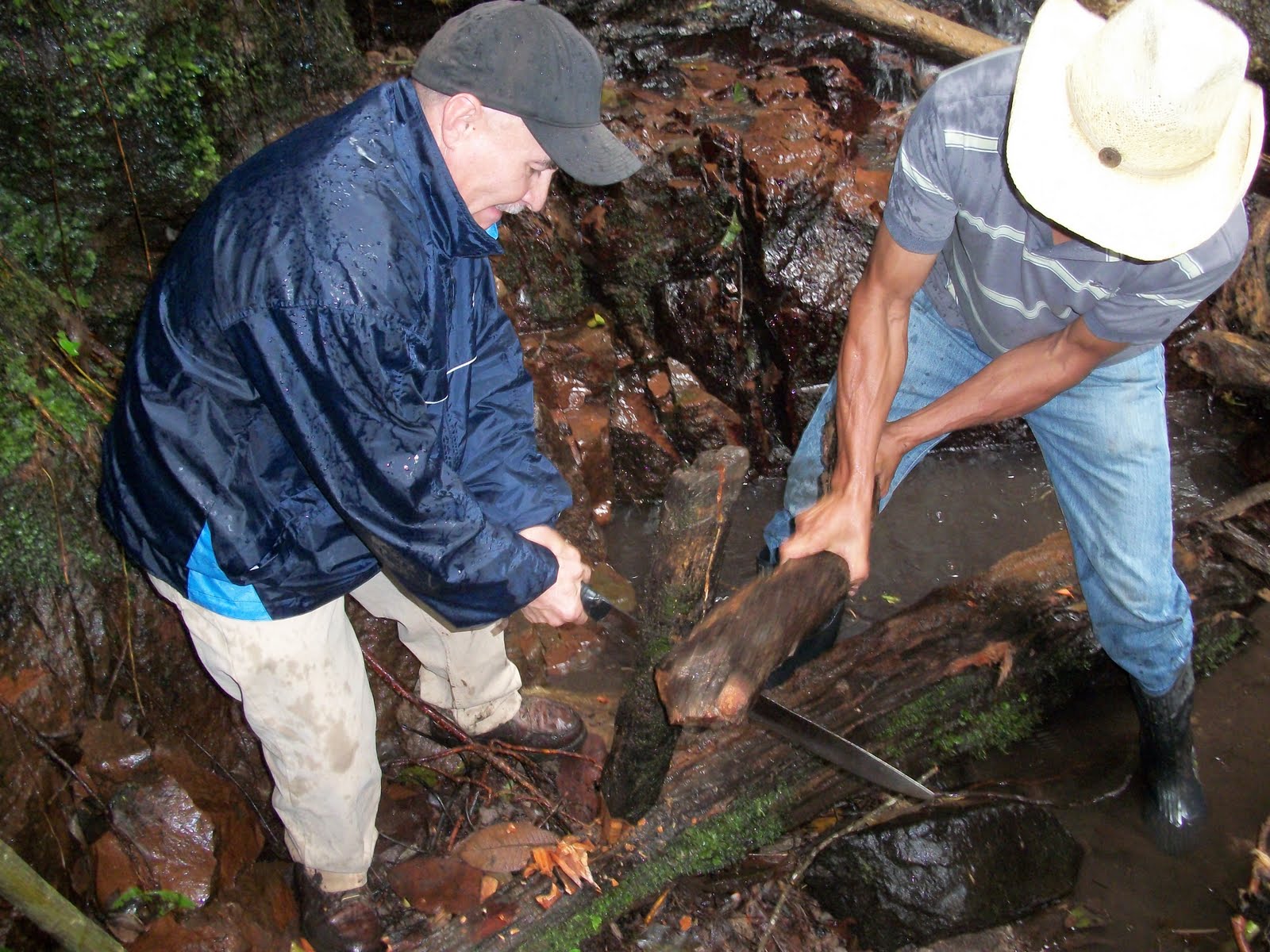
Once we get to the fuente, the only real uphill climb the whole day, the real work starts. We scramble down waterfalls and across rocky escarpments from one point to the next in a little train. Two guys are out in front blazing a trail through the woods by slashing down every bush (except coffee, cuidese with the cafĂ©) with their machetes. I’m convinced that Honduran men just love to chop things with their machetes, no matter how little it may actually need chopping; it’s a machismo thing. But they are handy with those things. They can chop down a small tree and make estacas (stakes) to mark our trail, they can slice through grass and brush that once seemed impenetrable, and one guy even made us a quick ladder/stepping log with notches carved in it in his spare time to help us down a rocky riverbank. I would probably chop my own foot off wielding those things, but it’s like an extension of their body almost. Off topic, but they can also cut the grass with machetes in towns where there is no lawn mower, which is quite often.

Making stakes

I was able to try my hand at surveying, which is easy and hard at the same time. All you do is look into a theodolite atop a tripod and read some numbers off (most of the day I was the note taker of those numbers). But you have to have a gentle hand to guide and then lock the theodolite in place and then focus it on the measuring stick in the distance to read the numbers. I tried it once then let Nolan take over. It was overall exhausting work, which I think I’ve mentioned before. Although you’re going mostly downhill, there is an occasional uphill stretch and when you are walking over big rocks and knee deep in bushes, you get tuckered out. Plus our lunch was about 2 hours late so I nearly passed out from starvation. The scenery was beautiful; the weather just about perfect and the company was friendly. The guys helping us out probably thought I was ridiculous, marching around in my rubber boots like one of the guys, but I think they secretly enjoyed my company.

Don't you love my boots?

Secret agent in the coffee bushes

We halted the study at 2:30 pm to be back in town in time for our 3 pm ride back. The NGO guy called at 5 to 3 saying they were waiting for us at the plaza and were about to leave, we convinced them to stay another 5 minutes. Of course, in Honduran fashion, when we got to the plaza, they were nowhere to be found and then called to say they would be there in 50 minutes, which later turned into about 75 minutes. And they said they were waiting, lies! All lies!

Feeling marooned, we walked a bit around the completely dead town, trying in vain to buy a refresco from the dozens of shops that were wide open with no one inside. It was eerily empty to 4 pm on a Monday. On the way back, I was exhausted, but those damn gravelly roads kept me from dozing off, as did our near brushes with death every three seconds. I noticed a binder in the pickup truck, a guide to the procedures of driving the truck from the NGO. I noted that the book probably strictly prohibited passing semi trucks on a two lane mountain highway with fog limiting visibility to about 20 feet, just a guess though.

I’d had enough after one day, achy all over and then catching a cold, so I let Nolan take over for the rest of the week. But I was still sad to say goodbye to our team of Honduran helpers, knowing that I would probably never return to the isolated community of Masaguara.

Church in Masaguara

Wednesday, October 13, 2010

Nothing special, just life

Things have been busy but at the same time slow, if that makes any sense. Nothing special of note has happened lately, but I thought I'd fill you all in a little on what we've been up to since I feel like our blogging has been sparse.

I participated in a family health taller (workshop) at the end of September, right here in La Esperanza coincidentally, to learn about how to give charlas on diarrhea, pneumonia, nutrition/malnutrition, safe water and healthy cooking. It was a cold and rainy week in La Esperanza for the taller so everyone was a little miserable. It was also awkward for me because the two community members I "brought" to the workshop I had never met before. I was supposed to start actually giving the charlas this week, but fijese que the budget proposal with the NGO wasn't ready and so we can't start until November. I'll be giving 6 hour charlas on the above topics plus cooking demonstrations in 20 communities from November through February, at least that's the plan right now. Things are always subject to change here. If it sounds like a lot, it is, but I'm really excited to be doing work that I'm more interested in.

I'm also working with two women's groups who make artesania to prepare them for an annual artisan fair at the US Embassy that the Peace Corps has helped sponsor the past two years. That's coming up the second week in December. I will be giving them each a charla on aspects of creating a business plan and then helping them take pictures of their products and write a brief bio that will go into a art fair catalog of all the participating groups, which I am also editing/creating. It will be a good opportunity for the groups to compare their products with other artisans and to get some face-to-face time with customers. It's only a little tricky because the groups are located 1 to 2 hours away so communicating information and doing advanced planning is difficult.

Nolan has had nearly nonstop work doing water studies. He completed one in September that he is still working on the design for since one house ended up higher than the tank, so there isn't enough pressure to get the water to that house. He did a quick sewage system survey here in La Esperanza just last week and still has to design that. This week, he's out in a nearby municipality doing another study. (I went with him Monday and a blog about that in specific is forthcoming). They're already trying to line him up to do two more in November! He is also going to start teaching high school chemistry (in Spanish of course) in about 2 weeks at a program called Maestro en Casa. It's like a GED program I guess, where people who never finished school can get their high school diploma by studying at home and having classes one day a week. Most of the people live in isolated rural communities and are either too old or too busy to go to traditional school. Maestro en Casa in La Esperanza has a good reputation and is run by a woman from the US who actually cares if students are learning or not, so the kids or adults really, generally do well. I think that will be exciting for him :)

Despite all this wonderful real work, it seems like day to day life is still moving at the same slow pace. I have been spending a lot of time at home preparing charla papers and when Nolan's doing a design, he's at home all day, so it's a bit boring. We watch a lot of movies and tv shows, our new favorite show is Community. We've been keeping up with Michigan football via internet radio on the weekends and doing a lot of cooking (bolognese, ginger ale, banana cake, zucchini bread, broccoli and chicken with penne). I also made some lovely curtains for the house (sewn by hand) to try to keep out some of the cold air. It hasn't rained in over a week now, which seems strange, so the town is a big cloud of dust. Oh yeah, and our landlord's/ex-host mom's son has apparently opened up a auto body repair shop in the garage right below our apartment which makes for lovely paint fumes and strange drilling noises at all hours.

Next week we're headed to El Salvador for 8 days to celebrate our 2 year wedding anniversary and Nolan's birthday! Look for pics and many new stories when we get back!


Tuesday, October 5, 2010

Nicki and Nolan’s Honduran Cider Mill

We couldn’t go any longer without having some tasty autumn cider, so we took matters into our own hands, we made some ourselves.

First, I’d like to share that where we live, we can actually get apples, Honduran apples. I couldn’t tell you the variety, but perhaps something akin to a Gala? Those pretty red, orangey, yellow kind that are small. They also sell USA apples here, the waxy looking ones like red delicious and granny smith, but those aren’t cidering apples. So we used the Honduran ones, ugly by US standards but still tasty. We bought 15 smallish apples for 30 lemps or $1.50, which is actually a little expensive for apples since it’s not the cosecha (harvest) right now.

The process was actually simple, but a little time consuming. We cored and chopped the apples then blended them in the licuadora as best we could, a little at a time so it took awhile. We then squeezed the pulpy substance a little at a time through a cheesecloth and viola, cider! We added a few sprigs of cinnamon and heated it up to pasteurize it then savored our fall treat with some homemade zucchini bread (a zucchini the size of my arm was only 5 lemps at the market). Our house sure smelled delicious.

Those 15 apples only made 2 glasses of cider though, either because they were small or because we don’t have the strength of an industrial apple press in our arms to properly extract all the juice. We’d have liked to make more but our arms were aching and the Michigan football game was almost on. We hope to try again next week if we can still find apples.

Part 2 involved using all the discarded apple pulp and pieces from the cider process. It felt wrong to just throw 4 cups of apple bits away. So we decided we’d try to make fruit leather, you know, the chewy dehydrated fruit snack. This process was equally straightforward. We mixed the leftover pulp with some orange juice, sugar and water and simmered it on the stove until the apples were soft and rehydrated. We further blended the mixture into an applesauce-like consistency. Then we spread the sauce on a pizza pan with some plastic wrap and let it sit in the oven which we heated up on and off for a day to dry it out. It actually turned out pretty delicious except for we left the oven on a little too long at the end and one part got kind of crispy. Still tasty though.

It was nice to be able to recreate some of our favorite fall traditions. It helps us not miss home so much. Plus it gives us something to do instead of work.

Tuesday, September 28, 2010

Autumn in La Esperanza…almost

El frio, it’s what everyone has been talking about. It’s been cloudy for nearly 6 days straight with on and off misty rain, turning the streets into puro lodo and temperatures have dropped. And I might be the only one that’s happy about it.

I was feeling depressed a few weeks ago. Work has been steady but uninspiring, fun activities at a minimum. Then, after listening to Michigan football games via internet radio every weekend, I was beginning to get homesick for the crisp, cool air, changing colors and warm apple cider that accompany every autumn, my favorite time of the year. Nothing here looked like fall, the pine trees still bright and vivid, the weather still moderately warm, no apples or pumpkins at the market. I had relinquished myself to making autumn leaves from construction paper to decorate our apartment when it happened.

The sky clouded over, and temperatures, although still in the 60’s, felt noticeably cooler. While in the US, this weather would still warrant shorts and flip flops no doubt, here, people have brought out oversized fluffy winter parkas, beanies, fleeces and scarves to keep out the chill. I awoke one morning to a slight mist which, when matched with a wintry smell in the air, almost fooled me into thinking snow was eminent. I commented to Nolan that, “It feels like the middle of winter here!” to which he smugly replied, “It is the middle of winter here.” Winter is over in December after all. On a trip to a community high in the surrounding mountains, I happened upon a wonderful sight, a solitary maple tree shedding it’s orangy-golden leaves in the midst of a pine forest. I was amazed. I followed this up with a trip to the grocery store where they were already stocking Christmas ribbons, nativity scenes and poinsettias, earlier than in the U.S. if you could believe it. (They don’t have Halloween and Thanksgiving to get in the way I guess).

It finally feels and looks (mas o menos) like it ought to in late September and the cold air has refreshed my spirits.

Wednesday, September 15, 2010

Emancipacion de la Patria

On September 15, 1821, Honduras, Guatemala, El Salvador, Nicaragua and Costa Rica declared their independence from Spain and joined the Mexican Empire. Just 2 years later the countries separated from Mexico to form a Republic of Central America, and when this didn’t work out, it wasn’t until November 15, 1838 that Honduras was finally and truly independent of all others. I guess Hondurans believed the break from Spain was the most important emancipation and thus, Sept 15th is the only “Independence” Day they celebrate.

And so it was a bright sunny Wednesday that my counterpart and I headed over to the central park for the festivities at 8 am. The park was jam packed with nearly the whole town, plus food vendors selling fries (with mayo, ketchup and queso seco – could there be a worse combination?), cotton candy, tacos, tajadas, ice cream (they don’t have another word for ice cream here, they just call it ihce crim), etc. Little kids were running and screaming all over the place, their hands sticky with sugar and sauce. You could barely find a hole in the crowd to get to the street. People were elbowing and shoving (something Hondurans are very adept at) to get through to the front, only to have the police come and push them back. Some people flat out ignored the police. Finally, at one point, two policemen grabbed a rope, tied it to a tree and then pulled it around the people to another pole, pulling tighter and tighter to force people to back up, like strangling them. You may think this inhumane, but it was necessary. People just didn’t get it! All the while they are dragging their kids along and have one arm holding a huge golf-like umbrella for shade. Of course the umbrellas mostly serve to block the view of everyone behind you and jab every other person in the head. Now, you may be thinking, oh sure, that happens in the U.S. too, nope, not like this. There were so many people in the street at one point that the parade couldn’t even pass through!

So, the main, and really the only, “festivity” was a parade of what seemed like every colegio (high school)student in town, dressed to the nines in freshly pressed uniforms and fancy shoes. The kids have a funny way of marching, a slow cantor with a foot shuffling motion, looking absolutely miserable, especially the girls in ridiculously high heels. It seemed to me like a graduation procession since the announcers were stating what path the students had studied, and the school year comes to an end in a few months so the timing makes sense.

Students marching

My favorite part though was the marching bands, well actually more like percussion ensembles. I only saw one group that had things like clarinets, trumpets and tubas, most had snare drums, bass drums, bongos, xylophones and those cans that you rub with metal to make a scratchy noise. Now let me first share with you that I can hear the bands practicing almost every night from my house and it doesn’t exactly please me. It’s rather annoying actually, one because there aren’t really songs with instruments so it sounds repetitive and two it’s loud and obnoxious. However, at a live performance, the marching bands are really something. A few of them were dressed in real marching band uniforms, the kind you might see at a college football game, so that was impressive. One band had some baton twirlers, including an adorable 4 year old little girl dressed in a blue corset and tutu ensemble, shaking her hips like Shakira. It was one of the cutest things I’ve ever seen.


The kids were all so focused and serious looking. They had these crazy and cool hand and body movements that they did. It wasn’t just marching down the street in a line, playing a song; it was as if each instrument group has its own moves and motions to accompany the songs. These kids were jumping around with arms flying everywhere in those big costumes, the poor things were practically dying from dehydration I imagine, the sweat soaking through every layer of their uniform. And yet every sequence or song they played seemed to last for 10 minutes! Then they’d start on another. The parading lasted for at least 3 hours! Now I can’t say that their sound quality or repertoire was magnificent, but their spirit, stamina and style could sure give the Michigan Marching Band a run for their money. Check out the video!


Feliz Dia de Independencia Honduras!

Friday, September 10, 2010

Anatomy 101

Michelle, Carrie, Sherria, and me

Having spent the last week translating 8 hours a day for a medical brigade, I feel all the sudden like I have a new command of the Spanish language and an ability to identify common Honduran ailments. This entry takes us back to the quaint town of Ojojona which, for those of you who remember, was the site of my 7 week business training. During training, our group befriended a local philanthropist of sorts, Don Ricardo, who, in addition to running an Italian restaurant, setting up a B&B, and having some sort of high position with the Belizean consulate, is also the founder and director of Amigos of Ojojona, a foundation dedicated to improving the pueblito. It was also he who 5 years ago randomly met a group of doctors from Pittsburgh and created with them a yearly medical brigade in Ojojona where people from all over the municipality could come and receive free medical consultations and medications. Don Ricardo had contacted our training group this year to come and translate for the doctors who spoke no Spanish, so 6 of us arrived to help out. Don Ricardo graciously provided all our food and lodging in his serene Ojojonan villa.

Medical brigades are very common here in Honduras, but the scale and organization of this brigade, or brigada, was larger than I imagined. Don Ricardo had hired 13 army officers to stand guard as well as drive three big army trucks to surrounding aldeas to pick up patients daily at 4 am. They set up big tents in front of the centro de salud (health center) where med students from Teguz did initial processing and vitals before patients were admitted to see one of 9 doctors (actually one was a nurse, the one I worked with). Included among them were a pediatrician, gynecologist and ophthalmologist. We also had a group of dental students one day who pulled teeth all day (literally, I’m not sure they did anything else). In addition to the doctors and us translating, there was an entire staff of Hondurans in charge of setting up the center, feeding us, managing the lines, helping with tricky cases and in general keeping order, although the extent to which they completed these tasks was only mildly satisfactory. All of the people who came from outside Ojojona were housed and fed, although the doctors stayed in a posh hotel in Teguz. The doctors also brought with them cases and boxes of medications to hand out, the value of which I heard was somewhere near $15,000.

Sunday began with a getting-to-know-everyone BBQ where I bumped elbows with the ambassadors to Spain and Panama as well as foreign service workers from the U.S. embassy and the recently arrived doctors from Pittsburgh. It was a little bit of culture shock to be talking with people from the U.S. who had little experience with or time in Honduras. While some of the doctors had been to Ojojona with the brigade before, some hadn’t. It was interesting to try to explain to them all the funny, interesting and ridiculous things about Honduras that we have come to know and tolerate in the last 6 months.

Monday through Friday we worked feverishly 8 hours a day to see close to 1000 patients. The little old men and women were cute, the little kids even cuter, and the sicknesses, problems, and issues we encountered and shared were sometimes disgusting, but always interesting. By the end of the week you could identify one of three types of patients. The first someone aptly named “trick-or-treaters,” the people who come complaining of every ailment known to man just to get as much free medication as they can. Most of the time they just had a cold/flu or head/back pain (and who wouldn’t here if you worked in the campo or made tortillas for a living). I never could quite figure out if they really didn’t know that something like Tylenol or Ibuprofen that they can easily buy at the pulperia would cure their average daily symptoms, or if they already knew this and still just wanted to get the free stuff. People are surprisingly enamored with a 30-supply of vitamins as it turns out.

People waiting in line

The second type I would call the “treatables.” These were people with mild to moderate health issues, yet still things that could be treatable with what meds we had. Things like ear/chest/sinus/urinary tract/yeast infections; skin issues such as fungus, rashes, scabies, lice; internal parasites/worms, acid reflux, high blood pressure etc. A part of this treatment, which I believe could have been emphasized more, was prevention and home management advice. If you keep your feet dry, you won’t get fungus. If you boil your water, you won’t get parasites. If you don’t eat spicy food, you won’t get heartburn etc etc. These were probably the people we helped the most, although getting them to change their habits to stay healthy in the future is questionable. I had to patiently explain to a 19 year old guy, and then subsequently to him and his 19 year old wife that they both had an STI that would just keep passing between them unless they both stopped having sex and took their antibiotics for awhile.

The third type of patient was something like “severe/terminal” and this was the saddest group of all. Kids with heart problems, asthma, malnutrition; women with severe depression or cancer; men with lung and respiratory problems and even schizophrenia. Most of these people had come to the centro de salud because they had already been to a hospital in Teguz and couldn’t afford the medicine and tests that the doctors had ordered. They came looking for things we couldn’t give them, xrays, echocardiograms, MRIs, specific medications. We could do so little for them, except refer them to specialists in Teguz where the cycle would just continue. It was heartbreaking.

We sped through all our Ibuprofen, Tylenol and heartburn meds in two days then had to buy more. After then we started only giving out 10-12 pills of pain killers per person, probably less that 1 week’s worth for them. I started to wonder if it was even worth it. We also took on the hilarious job of taking packages of prenatal vitamins and blacking-out the word ‘prenatal’ so non-pregnant women and men would agree to take them. My ‘exam room’ was one of three set up in a small room using wood frames and bed sheets to separate the spaces. This actually made it easier to yell across the room to another volunteer to get help with translating words you didn’t know. I learned how to take blood pressure (although I’m horrible at it) and checked many a person’s blood sugar levels. I had the chance to visit my host family a few times. They were so surprised and happy to see me. They repeatedly told me how much everyone had missed me, how everyone was always asking about me, and how I was the best host daughter they’d had (the only one they’d had to be exact). Many of the patients I saw were people who had hosted trainees or were neighbors of someone who did and so it was fun to chat with them and fill them in on what I’ve been up to. It felt good to come back to Ojojona, a place that I knew, to serve the community and get a new perspective.

Scratching 'Pre-natal' off of the vitamins

My exam room

I met so many fantastic people, exchanging emails and facebook info with a med student, our only Honduran translator, and our line manager. The doctors were great, including the head doctora at the Centro de Salud. We enjoyed a farewell dinner Friday night at an Argentine steakhouse in Teguz and were all I think a little sad to say goodbye. One of the doctors even delighted us with his Elvis impersonation (see below). We’re already making plans to reunite next year.

*Pictures courtesy of Carrie Perdue, Brett Johnson, and Sherria Snyder