Wednesday, March 28, 2012

Journey to the Center of the Earth

So if you haven’t brushed up on your Spanish in awhile, you might not realize that Ecuador means equator, for the obvious reason that the equator passes right through it. Quito is actually quite near the equator, hence the name which means, “Middle of the World” in a native language. The true 0 latitude point is not in Quito, but about 40 minutes outside the center to the north, a place we just had to visit. Called La Mitad del Mundo, this point was not only sacred to the indigenous people, it’s also a must-see tourist attraction, mostly to say you’ve stepped in the two hemispheres at once.

La Mitad del Mundo has two parts, the first a huge monument planted by the French marking the equatorial line, the second a small native museum marking true zero. According to modern GPS, the natives had it right all along while the French were about 240 meters off. The French monument is the more popular tourist destination with its massive concrete, globe-topped marker housed in a faux-village with overpriced shops and restaurants. Luckily it also had a few interesting museums with Ecuadorian art and an exhibit on the French exhibition to measure the curvature of the earth at the equator in 1743.

At the French equator
The native exhibit is separate and has a different character. A local guide led us through a maze of local vegetation while telling us stories of Ecuadorians who still live in today’s Amazon region. We saw shrunken heads, anaconda skins, blow guns and the local food staple, cuy (guinea pig). The guides also showed us a few tricks that can only be done on the equator. You can balance an egg on a nail head, something we both succeeded at. Draining water spirals in different directions whether you’re north or south (although we heard this was a crock). Also, it’s nearly impossible to walk with eyes closed and arms outstretched in a straight line.

Got it on the second try
Got it on the first try
The natives knew all along that zero degrees was in this exact spot, or rather in the area since one degree is about 112 km, the equator is sort of a wide band around the earth. They knew mostly because of the hours of sunlight, which are pretty much the same, no matter what the season. In fact, there really aren’t seasons, only a slight change in the shadow on a solar clock can tell you what time of year it is. And according to our guide, there are no major weather phenomena because of cancelling currents. The natives knew this place was sacred and it truly is a unique place.

Absolute zero
After straddling the equator, we went in search of a lunch place Andrew Zimmern had visited to try grilled cuy. We found the exact place thanks to the big sign out front with Zimmern’s picture and ordered one cuy platter for two. The guinea pigs were already partially grilled so the owner heated them over a hot flame to get the skin crispy, and in no time we were diving into our meal. The meat was a little hard to get at, there being so little of it, but it was hardly gamey. The legs, tenderloin and jowls were the best parts, complimented by the creamy bowl of potatoes we were served. Cuy is not a common food anymore and it’s relatively expensive, but it was an interesting culinary experience that one should have in the Andes.

Cuy asado con papas
If going to the center of the earth wasn’t enough, we also had to make it to one of the highest points “on” the equator, Cotopaxi. Just 17 km south of Quito, Cotopaxi is the second highest peak in Ecuador and one of the highest active volcanoes in the world at 5,897 m. It technically is higher than Mount Everest if you measure by distance to the core since the earth bulges significantly at the equator. We did a combined hiking and biking tour to visit this famous peak.

From Quito, we packed into a minibus with 15 other travelers and a roof full of mountain bikes. The drive south was beautiful – we passed other major volcanoes in the area with acres of fertile farmland stretching across their bases in geometric patterns. Unfortunately it was a little cloudy so we couldn’t see Cotopaxi’s magnificent snow-capped cone from afar. We had a briefing at a nature museum and munched on some coca leaf candies before starting the drive up half the volcano. Our bus broke down about three-quarters of the way up, so we had to wait for a 4x4 to come get us in shifts to take us up.

The starting point for the hike was a parking lot at about 4,500 m. The ascent was grueling. Three hundred meters of climbing at a 45 degree angle up unstable volcanic rock. It was like walking through sand with added hail pelting us. We had to stop every 15-20 steps just to catch our breath, so it took at least 2 hours to reach 4,800 m where a small refuge had been built to house climbers. After another less grueling 150 m, we were at the snowline, the highest point we could reach without real gear. We made snowballs and snow angels and rested.

Just barely able to lift our arms at the refugio
Equatorial snow angel
I've reached the top....sort of...
The views were stunning - below us rolling green and yellow plains below red and black volcanic rock, above blueish equatorial glaciers and behind them the peak of Cotopaxi barely visible behind the clouds. The sun came out for a bit and we soaked up the rays. What a great feeling to make it to the snow, even if the car did more than half the work. After a much quicker descent back to the parking lot, we hopped on bikes for the rest of the downhill. Going downhill on bikes was not especially fun for several reasons 1) it was raining, 2) the road was dirt and in bad condition so it felt like being on a washboard, 3) our hands got cold and numb really fast from constantly braking. It probably would have been better in clearer weather, but as it was, after a long hike, we were more than happy to get off the bikes after about 15 km. After a comedic attempt to stuff 17 bikes into a new bus, we headed back toward Quito, stopping for a much needed dinner at a local hacienda.

Still smiling despite the rain
From the middle of the earth to nearly the top of it, the environs of Quito provided us with plenty of opportunities to have some unforgettable experiences. 

Tuesday, March 27, 2012

In the Southern Hemisphere

As soon as we began nearing the Colombia-Ecuador border, we could tell that a change was taking place. The landscape was transforming from lush tropical mountains to farm-covered hills and the people had different features and wore different clothes. Although we had been in the Andes since Bogotá, the Ecuadorian Andina region seemed to fit the image we had in our head of men in ponchos leading llamas and women in fedoras. It was also immediately obvious that Ecuador was less developed, starting with the more dilapidated and time-consuming bus we ended up on toward Quito. It was like being back in Honduras again, something familiar but also a bit annoying.

Arriving in Quito to afternoon rain, hungry, dirty, tired and then trying to navigate a confusing bus system did not shed a good first light on the city. Luckily our hostel, although staffed by a lackadaisical Australian, was clean, well-located and ready, so once we showered and rested, we were ready to find the real Quito.

Quito is a big city with 2.2 million people, but it’s restrained by geography in a narrow valley only 8 km across, so it’s really long and dense. It’s also in the southern hemisphere which marks just the third time each of us has been in this half of the world. It has one of the best preserved and remodeled old town’s in all of Latin America, which was obvious as we explored the streets around the Plaza Grande. We peeked inside a few very colorfully painted churches and stopped in an interesting museum of Ecuadorian artist Jorge Chalco. Our hostel was in a pleasant plaza dating back to the 1500’s and was close to a series of parks which housed the national observatory.

Chalco painting
Our hostel was the pink one on the left
Just up the hill from us was the Basilica del Voto Nacional, a huge gothic cathedral built cleverly on a hill to maximize views. We climbed the rickety ladder-like steps to the top of a few of the towers to snap some great panoramic shots of the city. Volcan Pichincha was to the west, largely undeveloped and always cloudy on top. Mariscal Sucre, the hip and happening bar/tourist neighborhood, was to the north. To the east was your typical cityscape. And to the south was old town Quito with the Virgin on the hill rising behind it like an eerie omen. In the distance, volcanoes loomed, although we could see nothing but a few tips, the rest hidden by the ever-present clouds.

Flying buttresses on the basilica
Southern view of the city from the top of the basilica
We expected the food to be familiar. However we quickly found that menus had foreign-looking words and unusual dishes like llapingacho and fanesca. The typical lunch plate, like in Colombia, was a bowl of soup followed by chicken, meat or fish with rice and potato salad, only in Ecuador it was about half the price. Potatoes grow well here so are served in everything from soup to salad to plain boiled or grilled on a skewer with meat. Popcorn is also big here; you are served a little bowl of it with lunch to toss into your soup, but we didn’t figure that out until later. They eat a lot of fish and seafood, despite not being near the ocean.

Fish soup with popcorn
One evening, as we were walking back to our hotel, we passed by a huge park where a lot of people were gathering, separated from town by a blockade of policeman. We didn’t think too much of it. Then people began to march down the street toward the central plaza, waving big Ecuadorian flags playing drums and trumpets. We flipped on the t.v. to see the news. Turns out it was a big pro-presidential rally for Rafael Correa, the current president who has had a lot of support and success with programs that seem to be helping Ecuador. He was able to basically get out of the majority of the national debt owed to foreign countries by claiming that it had been leant to past corrupt governments so wasn’t legal debt. However recently, he proposed a water policy that negatively affects many rural people, so they were protesting against him. To oppose their protests, pro-Correa activists proposed a support rally. We ended up heading to the plaza to try to get a peek at the president, but no such luck. We did hear the people chant “Correa, amigo. El pueblo esta contigo!” (Correa, friend, the people are with you!) which I thought was clever. It was an interesting, if brief, look into Ecuadorian politics.

Us in the Plaza Grade (central park)
Overall, Quito seems to be sort of like Bogotá’s kid sister, always trying to do things as good as the older sister, but not yet old enough to really do them. They have a bus rapid transit system that is a little dirtier and covers less area. They have a ciclovia that is less utilized and offers fewer routes. But little sister’s grow up sometime, so we have hope for Quito.

Playing around with some statues on La Ronda (artisan street)

Thursday, March 22, 2012

A planner's paradise...almost

As urban planners and urban lovers, Bogotá really impressed us with some of its features making city life more enjoyable. The three we noticed and took part in were 1) the bus rapid transit (BRT) system, 2) the extensive bicycle infrastructure and 3) park space.

Bus Rapid Transit

There is a reason that Bogotá is known the world over as a model for BRT systems; the system works successfully and efficiently. The system, called the TransMilenio, opened in 2000 and has since completed a second phase giving it a total of 84 km (52 mi) of lines with 114 stations and 1,500 buses. A third phase adding additional lines and stations is already in the works, and the ultimate goal is to have over 300 km of lines. The system serves 1.6 million people a day, which is about 1/5 of Bogotá’s population! The one trip cost is 1750 Colombian pesos (COP), about US$1, which is relatively affordable given that other city buses running various routes charge 1450 COP.

TransMilenio articulated bus
The difference between a regular bus system and BRT is that BRT operates generally using raised platform stations where you purchase tickets in advance to avoid wait times upon entering and the buses have their own dedicated lanes apart from traffic, speeding up their service. At first we found Bogotá’s system sort of difficult to navigate. Instead of each line or section of the system having a color, letter, or number, they have all three. Certain numbered and lettered routes go in certain directions and stop at certain stations and others skip stops, like local versus express service. Each station has 2 to 3 gates for multiple buses to stop at once to avoid congestion. You can purchase fare cards for multiple rides, but we read that people were suspicious of this working and generally only buy one trip at a time. After a few miscues, we got the hang of it quickly.

Station and dedicated lanes separated from regular traffic
The stations were roomy and clean, as were the buses, although at rush hour they were completely packed and a little stuffy. The main lines run along major streets so there was plenty of room for the stations and dedicated lanes in the middle of 4 or more lanes of other traffic each direction and medians. The stations on these busy streets also had safe, police-guarded walkways to take you from the center to either side of the street. The stations/lines on the smaller streets were well designed with some nice brickwork and pedestrian crossings. They also have a system of feeder buses that people use to get to areas off the main lines.

Inside a station
While it’s not a more refined subway or streetcar system, it is a far cry from the haphazard system of random personal bus companies that most Latin American cities still have. And, it’s an improvement over traditional bus systems in the U.S., which is why cities like Detroit are looking into it in order to cheaply and quickly improve their antiquated transit services.

Bicycle Infrastructure

Colombians are avid cyclers, both professionally and recreationally, so it’s not surprising that Bogotá offers great bike facilities. In addition to the normal things like bike parking, they have a super network of bike paths that zigzag across the city for over 300 km. The paths are generally well protected and separated from traffic and pedestrian walkways and are often in a roomy median. The great facilities mean that 5%, around 350,000, of trips in the city are made by bike. Bike shops are a common sight on almost every street.

Bike lane in median of a wide boulevard
Not only do they have great bike infrastructure, Bogotá is also credited with inventing a unique biking event in 1976 called the Ciclovía. Every Sunday and holidays falling on Monday, the city closes 120 km of streets to vehicular traffic from 7 am to 2 pm in order to create routes solely for bikers and pedestrians. The event has grown exponentially in popularity since its inception, particularly since the 1990’s when the city took efforts to improve biker safety.

Ciclovía lane designation sign
We were lucky enough to be in Bogotá on a Sunday to witness the event which is so much more than opening some bike paths. Millions (yes, millions) of people turn out every week to get some exercise in whatever way they choose: biking, roller-skating, skateboarding, jogging, walking or participating in one of many free exercise and dance classes offered in public parks. Families with kids, single women, groups of teenagers, and old men are all present, beaming with smiles and dressed in their best exercise gear. For bikers, there are some special amenities like bike service stations that will fix a flat or adjust your gears. For everyone, there are street performers, drink and snack stations and teams of police and Bikewatch (so called because Baywatch was popular when they started) patrolling the area to direct traffic and provide general assistance.

Bikers stopped at an intersection for cars to pass
While we didn’t have bikes to ride, it was still fun to walk the streets, try a rumba class (really hard!) and take in the vibrant and exuberant atmosphere that pervades the city and its residents. Everyone was out to have a great experience, and it was such a lovely time to explore the downtown area without worrying about the traffic or pollution that come with cars, trucks and buses. It’s no wonder this event has been replicated across Colombia and is now spreading to other countries including Australia, U.S., Canada, Mexico, Ecuador, Peru and Argentina. We think it would be a great event for any size city, even if it can only be during the summer months or a few times a year to start.

Exercise dance class in the park
Park Space

Lastly, Bogotá has a great park system that seems to be well-utilized and maintained. The city has park spaces scattered all over which have some of the best landscaping we’ve seen in Latin America thus far. They really put some effort into designing spaces that were pleasant for sitting, strolling or grabbing a snack and ample garbage and recycling containers plus street sweepers meant they were mostly trash- free. One space we saw even had a winding fountain-like water feature that covered several city blocks in order to replicate an old river that had been buried.

The highlight was certainly the Simón Bolívar Metropolitan Park, really a series of three parks and a botanical garden that covers 988 acres! The botanical garden is a great urban oasis featuring a variety of environments from coniferous forests to desert-scapes, a tropical plant house and herb and vegetable gardens. At less than $2 for entry, it was a great deal, and we spent a good 2 hours enjoying its winding paths and cool climate.

Rose garden at the botanical gardens
The other three parks were packed with a variety of offerings from an aquatic center and multi-sports complex to an amusement park, children’s museum, library and a mini lake. On Saturday, hundreds of kids and adults were out participating in everything from inline skating and tennis, to basketball, volleyball and of course, soccer. The lake was smooth and serene, with rowboats to rent and tons of food kiosks lining its shores. They had a special area alongside with public exercise equipment as well. What was also impressive was the number of kid’s junglegyms and playgrounds that had been constructed in every corner of every park and also in every apartment building complex. Compared to Honduras, which has maybe 10 playgrounds in the whole country, Bogotá was a kid’s dream come true. We wandered for hours along the manicured paths, soaking up the sun and people-watching.

Lake in the park
If you couldn’t tell from our descriptions, we loved Bogotá and all it had to offer. Despite its massive size, we never felt overwhelmed and could almost see ourselves living there, biking to work and enjoying the park system as much as the locals clearly do. While not without its faults, Bogotá is a great city for others to look to as a model of some fantastic urban planning practices, and we hope to have the chance to visit again the future.

Tuesday, March 20, 2012

Bustling Bogotá

After an agonizing 20-hour turned 26-hour bus ride from Cartagena, we pulled into the bus terminal and breathed a sigh of relief that we were out of the hot coastal area and instead sitting comfortably at 2,600 m (~8,500 ft) in Bogotá, the fourth highest capital in the world after La Paz, Quito, and Thimpu. The bus ride had us scared for a second when it departed Cartagena northward, travelling along the Caribbean Coast. We were sure we’d gotten on the wrong bus until we eventually turned southward, the first of many strange twists and turns the bus would take to arrive at the centrally located capital. We hopped on an urban busito and headed for our hostel, finding it with no trouble despite the street numbers having recently been changed. It was refreshing to be in a real big city, and it helped that the annual temperature hovers steadily around 60 degrees.

We started our city exploration with an early morning trip up to Cerro Monserrate, one of many large mountain peaks that create Bogota’s eastern urban border. The funicular train was out of service, so we zipped 200 meters up to the top via cable car. The views were breathtaking, literally. Having just come from sea level to 2,800 meters, every step seemed like a huge chore and we were soon winded. Fittingly, at the top, dozens of little shops sell coca tea, leaves of the same plant that produces cocaine, which are steeped and sugared to make a tasty fusion that cures altitude sickness (well, it tasted grassy to be honest, but the sugar helped). It seemed to work, since we didn’t have any more problems in Bogotá. We snapped dozens of shots of the church that sits atop the mount and the manicured gardens, shops and restaurants that surround it. People do hike up the mountain as a sort of penitence, but we heard it was dangerous so we cabled car-ed it back down.

View of the cable car and city from the top

Tasting coca tea - Don't worry, it's not illegal!

View over sprawling Bogotá

The funniest thing happened when we were up there though. A group of high school kids approached us in a furry and began asking us all kinds of questions, where we were from, if we spoke Spanish, if we had kids, where we were travelling. They were trying to pretend they knew English but could only get out “cost of transportation?” Hah. They also thought Nolan could pass for a Colombiano. It was a little intimidating having 20 kids all asking you questions at once and cooing every time you answered, but it was funny too. As soon as they saw some other gringos, they ditched us. Maybe it was a class assignment to talk to foreigners?

At the base of the cerro, we stopped in at Quinta de Bolívar, the temporary house or inn of the legendary Simon Bolívar from 1820 until 1830. Bolívar led many countries in South America to freedom from Spain (more on him later) and as such, is always referred to as “the Liberator.” The house wasn’t specially built for him or anything, and he only sort of temporarily lived there with his wife/mistress Manuela, but it was a great peek into the life and times of colonial Colombia. It had an extensive labyrinth of manicured gardens and a vegetable/medicinal/herb plot. The house itself had some great period furniture and a replica of a famous sword given to Bolívar by the city of Lima. It also had a fantastic breezy dining room where in the early 1800’s, the signs explained, culinary habits were beginning to change from full-service to buffet style. The kitchen was of course my favorite room with a huge blackened stove, old skin wine casks and antique utensils. It was serene spending time at his little hacienda, removed from the bustle of the city and nestled in the foothills.

Kitchen inside la Quinta

Gardens at la Quinta
Bogotá had so many great sights to see, it was hard to take them all in. With over 7.8 million people and an urban footprint of 613 square miles, we barely scratched the surface in our few days there. We stayed in the La Candelaria district, which is basically the old town. However it didn’t have exactly the Spanish colonial feel of other places we’ve visited. While there were some colorful colonial buildings, we also spotted art deco and even English style row homes in addition to the newer apartments and high rises that are beginning to infiltrate the downtown core. La Candelaria has a cluster of churches and restaurants which make it pleasant for strolling. It’s also home to Plaza Bolívar, a Trafalgar Square-esque place that has the primary cathedral, but also the Supreme Court building, city hall of Bogotá, and the building of the National Congress which backs up to the president’s quarters and other governmental buildings. It was very monumental to say the least, but not as pleasant as some other parks we visited later on.

Congress Building in Plaza Bolívar
Bogotá is known as the “Athens of Latin America” due to its high concentration of universities, which we can attest to having walked past dozens of them as we strolled the streets. It also has some great museums we visited. The first was the Donación Botero, a collection of works done by Francisco Botero himself and other famous artists from his personal collection. Botero is a contemporary Colombian artist, from Medellín actually, that has a peculiar style of painting and sculpting everything quite fat. Not just people, but animals, fruits and even furniture have a stocky nature to them. He’s quite famous and the museum housed a wonderful collection of his works, augmented by Picasso’s, Monet’s and others.

Botero hand
Botero Mona Lisa
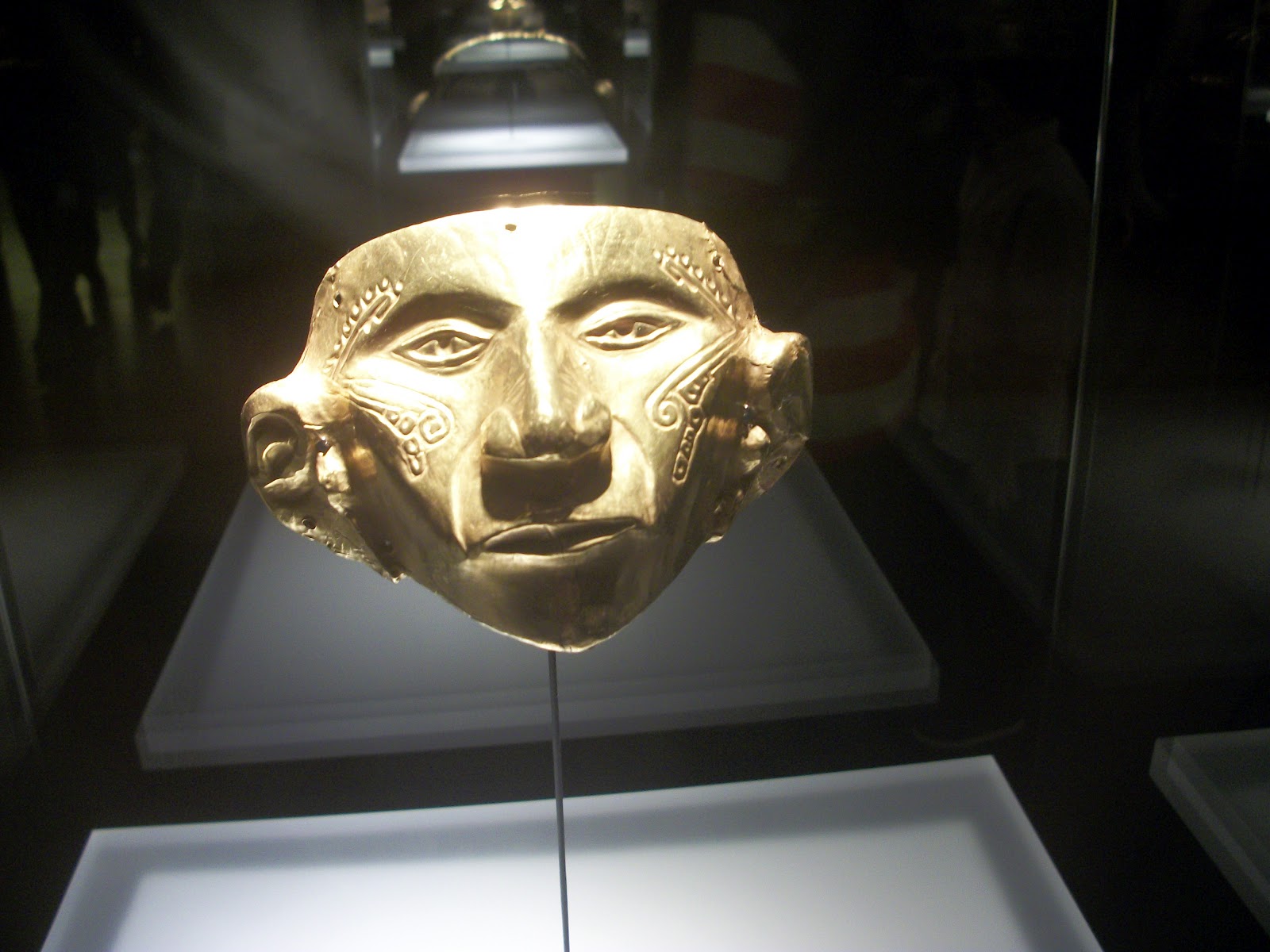
 The second and even more famous museum is the Museo de Oro, or gold museum, which has a huge collection of Pre-Colombian gold artifacts from all over the country. It was really well done with all the information in well-written English (surprise!) and had thousands and thousands of amazing pieces. We saw everything from jewelry and ornamental sculptures to tools used in religious ceremonies and musical instruments. Amazingly, the Native Americans were skilled at making alloys with gold, platinum, bronze, copper and silver and perfected many techniques including hammering and the lost wax process.

Gold mask
In between all this sightseeing, we enjoyed a variety of delicious food. Colombia and Panama don’t have tortillas like many other Latin countries. Their equivalent is the arepa, which I previously mentioned, a thick cornmeal patty grilled and stuffed with a variety of ingredients. We found that eggs or shredded meat and cheese are the best, hot off the street from a guy with a grill on the front of his bike! Genius! They also sell amazing fresh potato chips and sweet churros on the street, as well as fried sausages and a grilled corn (choclo), which is so crispy after grilling that it tastes almost like popcorn. Empanadas abound with every filling imaginable, including a mix of cheese and guava jelly (not great). Colombian’s also love their sweets, particularly anything flavored with caramel syrup called arequipe. They eat it smeared between two wafer discs with other toppings like jelly or cheese. 
Bogotanos in particular are getting into microbrews and they have a famous chain called the Bogota Beer Company, which we stopped at to have some tasty Belgian style ales. We felt like we were back in the States, sipping delicious beer among hip and trendy college kids and young professionals. We heard Colombia has great hamburgers, but the few we tried weren’t that spectacular. Sadly we also missed out on eating lechona (a stuffed pig) and ajiaco (chicken and potato stew), since most of the restaurants were closed both Saturday and Sunday afternoon/evening. We did buy a famous Chamba ceramic cooking pot though which will be great to try making beans or stews in back home.

Wafer with arequipe

Crispy choclo
But beyond the food and the culture, what we loved most about Bogotá, was its urban-ness… which is the subject of the upcoming blog, so stay tuned!

Thursday, March 15, 2012

On a new continent

With our arrival in Cartagena, we stepped foot on another continent(!), although really nothing much appeared to have changed. Cartagena seemed a lot like Panama City, an old colonial town separated from a new beach and high rise sector. Yet Cartagena had a very vibrant feel and more beautifully restored buildings. We spent most of the time walking within the walled old city which, in addition to the typical ornate churches and repetitive souvenir shops, had tons of upscale shopping, dining and hotels plus more bookstores (3) per square mile than we’ve seen anywhere else in Latin America. The parks were wonderfully landscaped and bustling with break dancers, colorful fruit vendors and mobile ice cream and beer (yes, beer) vendors.


We love the colors and the cool vine of this streetscape
Something akin to the Chiquita banana lady
Interesting mixed market - flowers and typing services
 We spent lots of time wandering the cobbled streets among horse carts and sampling the cheap and delicious local food. The street food was a variety of fried doughy items stuffed with eggs, potatoes or meat. The most common is an arepa which is a grilled or fried corn tortilla meal stuffed with cheese, meat, eggs or margarine. They also have amazing set lunch dinner specials that include a bowl of soup, a plate of meat/rice/salad/beans and juice for about $3 – yummy and cheap!

Chicken soup and fried fish lunch plate all for $3!
 Although Cartagena has a wall around it, built for protection from sea attacks, it also has a huge fort on the hill behind town to protect from land attacks, el Castillo de San Felipe. It was a short but extremely hot walk from out hotel to arrive at the entrance where thousands of cruise ship passengers had begun to swarm. Amidst pestering vendors, we climbed the fort and explored its batteries and dark underground storage tunnels. There were great views of the new and old towns and the water beyond – too bad it was so hot and humid. We also checked out an interesting city museum housed in the old Palace of the Inquisition. This was the spot where heretics and witches were accused, tried and tortured in the name of the Catholic Church. Today it is restored and has a great exhibit about how Cartagena came to thrive as a major Caribbean trading port with an ethnic mix of citizens, but then lost power as a result of its quest for independence from Spain. It lapsed into a city decimated by disease and lost investment and it’s only in the last 100 years that it has again begun to redevelop.

Looking up at the fort
On top of the fort with the city behind
 On our last day, we took a tour to Volcan Totumo, a dry conical volcano-like column of medicinal mud that bubbles up from the earth. It’s a popular spot 45 minutes from the city to go soak for awhile and then wash off in the nearby lake, which is exactly what we did. They have a series of helpers that pull you into the mud pit, slather you with mud, give you a massage and then push you around. The mud has a strange consistency and even though the volcano is hundreds of meters deep, because of the density, people just float on the top at about chest level. It’s scary to think about just floating there on to, but you can’t really move much without help. We were packed in with about 40 other people and soaked for awhile. They slough the mud off you and you can let it dry like a mud mask to purify the skin. Then you hop in the lake nearby to rinse it off. It was quite an experience – one we would highly recommend to anyone visiting.

Before our soak in the volcano
It's nearly impossible to move in the mud, not up, down, or sideways
Let the mud dry before you wash off to maximize the benefits
Despite still feeling the rocking sensation from out boat trip three days later, we enjoyed exploring Cartagena, even the dingier local areas where we hunted out cheap food and great photos. We found the people to be very helpful and thoughtful. The housekeeper at our hotel was so sweet, when we left, she said she would miss having us at breakfast in the morning! Even though Cartagena was a stunning city (the old town at least), we were happy to move on to cooler weather in the Andes in Bogotá, which is exactly where a 26 hour bus trip landed us next. 

Sunday, March 11, 2012

A pirate’s life is not the life for us

What we discovered after 5 days and 5 nights crossing the Caribbean from Portobelo, Panama to Cartagena, Colombia is that we are land lubbers. Let me explain. Portobelo is a small, breezy port town with nothing more than a few old forts and one backpacker hostel where we met our boat crew and fellow voyagers for our trip. We boarded the ship late in the afternoon for an all night ride out to the San Blas Islands off the northeast coast of Panama. As George Kastanza would have said, “The sea was angry that day my friends.” Within hours of departing and despite taking several seasickness pills, the huge rolling waves whipped up by brutal wind sent me spewing my lunch and dinner over the side of our brigantine schooner. I wasn’t the only one. During the course of the night, almost everyone on board was sick, even Nolan who normally has a stomach of steel. We had the roomiest “double suite” which was no more than a slim triangular bed tucked in a corner of the bow that was hot, stuffy and uncomfortable, but so much better than the layered bunk beds. Laying down provided the only relief from sickness, but being below deck was the last place one wanted to be.

View of Portobelo from the mountain lookout
Remnants of the Portobelo fort
Our boat (a 64 ft brigantine schooner) is the one to the right behind the front boat
Our cabin
Waking up to smooth seas and an eyeful of palm tree encrusted islets was a wholly uplifting event. With the boat anchored, we had time to do some snorkeling and swimming, as well as explore the nearby uninhabited islands. The smooth water made for easier sleeping and eating. Despite the cloudiness, there was no rain and we enjoyed relaxing on deck, chatting with our fellow travelers. There were 11 of us in total including a couple from Canada, a German woman, a guy from Sweden, a married man from China, and of course four motley Australian lads. We all shared a love of travel, most of us having either left or just finished jobs/school. It was a pretty picture all of us sitting around the keel, able to communicate in English, sharing stories about crazy bus rides, amazing cultural experiences and future plans. Our captain and crew fit right in, having their own plethora of interesting backgrounds.

One of the San Blas islands
Happy to be on smooth waters
We were anchored in two spots over three days and two nights, with plenty of downtime to get our sea legs and soak up the intermittent sun. One night we were able to go ashore in groups in the dingy and Nolan built a huge bonfire on the windy beach that we cherished under a full moon. It was absolutely beautiful and serene. We were expecting to meet and interact with some local Kuna Yala people who inhabit the San Blas islands, but the closest we got were watching them paddle out fishing boats for their morning catch. One came aboard to sell us some lobsters which became our dinner. The Kuna have autonomy from the Panamanian government and inhabit the islands of which there are 365 as well as a piece of the mainland. They have a distinctly traditional dress, language and style of living based on subsistence fishing and harvesting coconuts. It is in fact illegal to touch, take or use any coconut found in the vicinity under risk of punishment. They also sew interesting fabric designs to adorn their clothing, which we were hoping to buy to turn into pillows, but no one came to sell us any.
Kuna Yala fisherman off the port bow
The last stretch of our trip was a 42 hour sea passage across open ocean, the part we most dreaded. Feeling sticky from salty air and not truly showering for 3 days, we hunkered down in our cabin and upped the dosage of Dramamine. To my surprise, I didn’t get sick and neither did Nolan! We had become one with the sea! I skipped the first dinner and breakfast, but then ate lunch and dinner while the waves were minimal before heading back to bed for the last 12 hour stretch. I was able to make it to and from the bathroom with no problems (which before was a living nightmare) and even came up top a few times to admire the land-less views and moonlit night sky. The immensity of the ocean, especially at night, is inexplicable. It’s both scary and invigorating to realize that it’s just you in a tiny boat and all that water.

Us aboard the boat
After all that, we woke up this morning as we were pulling into the Cartagena harbor. The city was misty in the morning haze as we said goodbye to the boat and crew and piled in the dingy headed for the dock. Now, more than 12 hours later, I still have the sensation that I’m aboard the boat, rocking and bobbing in a way that makes me want to pass out. Figures – just as I got my sea legs, I lost my land ones. Hopefully a good night’s sleep will cure me of that. After the first day, I really thought we had made a bad choice in taking the boat. But the whole experience was quite unique and in addition to meeting some great people and having fun island hopping, we learned to really appreciate the water and the challenges and beauty that it can bring. I think Jack Sparrow says it best, “It’s not just a keel and a hull and a deck and sails. That’s what a ship needs. But what a ship is…is freedom.”

P.S. We are happy to recommend our boat tour through One World Sailing. Feel free to leave us a message if you have questions about the trip logistics. We'd be happy to help.